

US Finally Capitulates with 'Memorandum' of Surrender

The US has finally capitulated in its disastrously failed war against Iran, reportedly drafting a memorandum of understanding which is highly favorable to the Islamic Republic, and gains as concession nothing more than the promise that “Iran will not obtain nuclear weapons”—a position Iran had already long held.

The most explosive detail is the alleged $300 billion “reconstruction fund” that Iran will be entitled to once the deal is sealed.
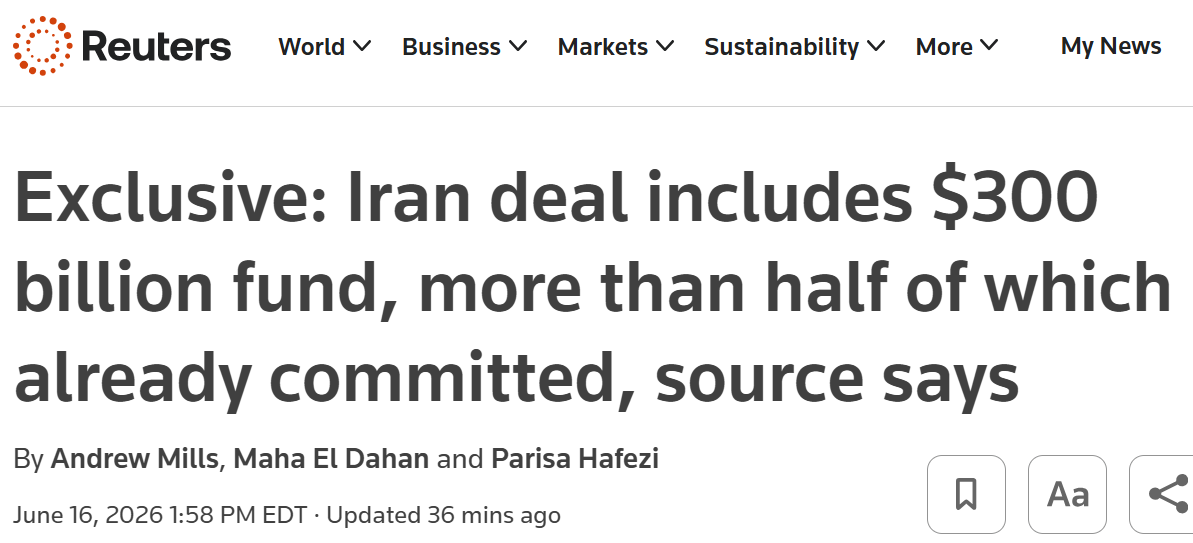
Trump has downplayed or denied this point, with everyone seemingly perplexed as to what this massive sum entails, exactly. In the above article, Reuters writes the following:
The new fund is a private investment vehicle, not a reconstruction or reparations program and will not include any government money or grants, the source said, adding that companies based in the U.S., the Gulf Arab states, Asia, South America and Africa have agreed to commit financing.
Investments pledged span energy, logistics, manufacturing and transport, the source said.
They claim it’s not a reparations program, yet the official name of the fund is the ‘Reconstruction and Development Fund’. It appears to revolve around regional entities—both corporate and governmental—providing credit lines, direct financing, etc., to Iran. As can be seen above, over half of the fund is claimed to be already committed.
Some American propaganda pundits had claimed that this fund is being pulled from Iran’s frozen assets abroad, but Reuters begs to differ, citing that as an entirely separate negotiating track:
The investment fund is entirely separate from a parallel negotiating track over the lifting of U.S. sanctions and the release of Iranian sovereign assets frozen abroad, the source said, describing the two as distinct financial mechanisms with different purposes and timelines.
Most interestingly, is this follows revelations of secret deals having been attempted during the war between Qatar and Iran which aimed to put pressure on the US to stop its attacks by essentially pulling the plug on the global economy. From WaPo:
Seeking to protect its economic crown jewel, these officials said, Qatar approached Tehran at the start of the war to present a mutually beneficial arrangement: Iran would refrain from hitting Ras Laffan, and Qatar would halt gas production unilaterally — a move that would send energy prices soaring and put economic pressure on the United States and Israel to shorten the war.
Qatar presented what amounted to a “secret deal,” said a senior regional security official, vowing to use leverage over gas supplies to help bring the war to a swift end while seeking Iran’s commitment on “one condition: you are not going to attack us.”
That’s just the first one.
The Israel Hayom outlet made an even bigger bombshell, claiming that Trump secretly approved a cash deal between Qatar and Iran which allowed Qatari ships to secretly whisk oil out through the strait:
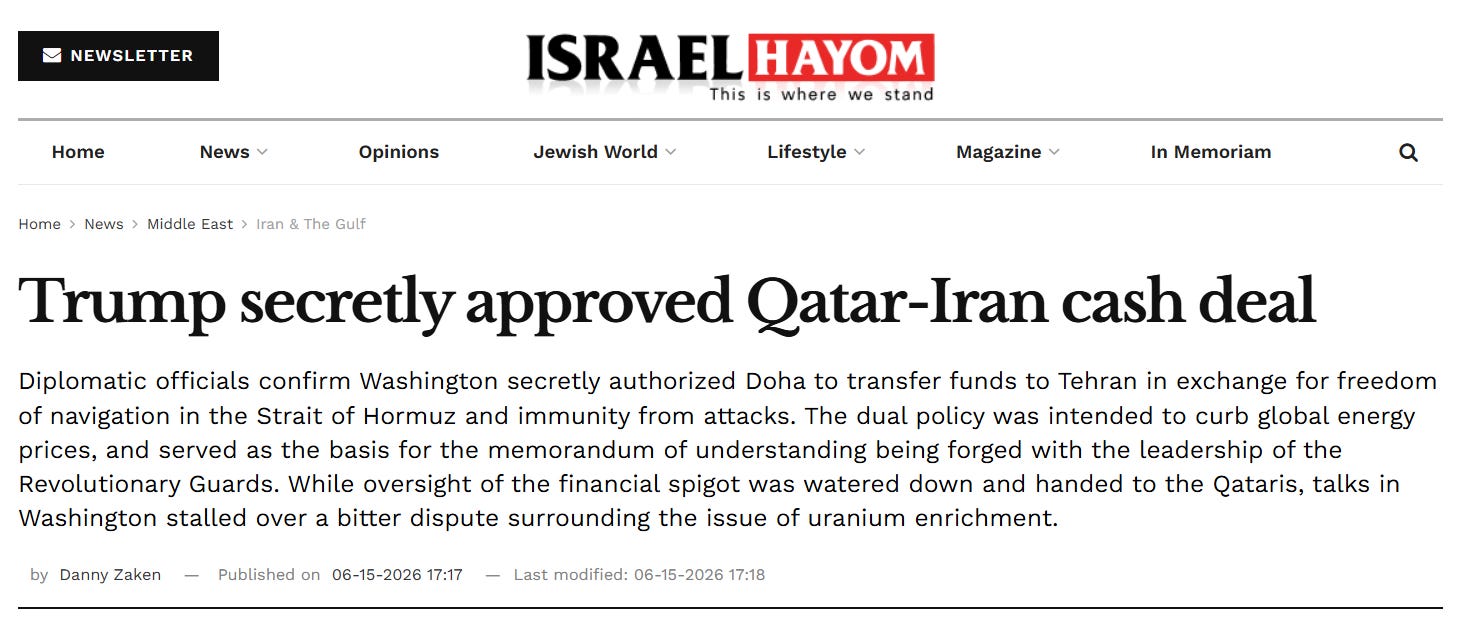
The US secretly approved a financial and maritime arrangement between Qatar and Iran, under which billions of dollars were paid to Tehran in exchange for free passage for Qatari tankers and ships through the Strait of Hormuz, three diplomatic officials now confirm.
It’s difficult to know how much of this is true, but it does paint a clear picture of one obvious reality: that Iran always held all the cards, and maintained total escalation dominance. This caused all other hostile actors to repeatedly scramble for various secret deals and concessions of appeasement as tithe or tribute to the Iranian overlords which now rule the region. And this happened while the same actors all put on a “bold face” of courage and defiance against Iran, when in reality they were terrified of the looming consequences.
And the chief of those consequences, according to experts who have been growing increasingly panicked these past two weeks, was that the US’s SPR (Strategic Petroleum Reserve) and Cushing, OK crude inventories had been heading toward rock bottom levels. Experts warned that below ~20 million barrels or so, the Cushing storage infrastructure begins to severely malfunction, with pipelines losing pressure.
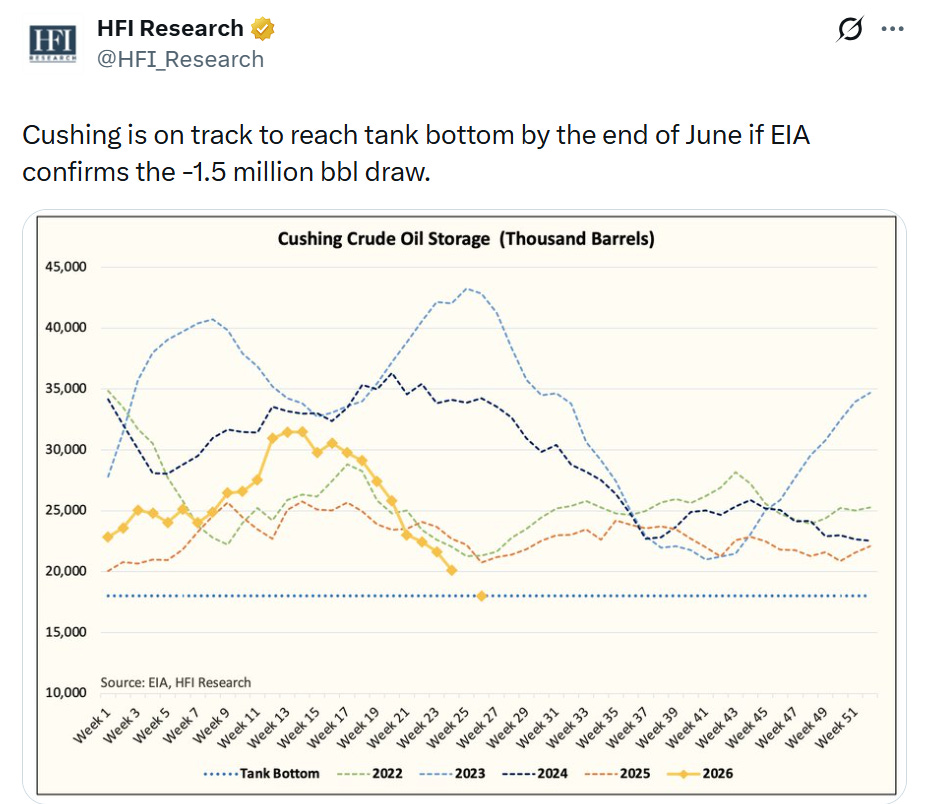
In short, Iran called Trump’s bluff and won. Trump tried to pretend that the US could play the long game in “blockading” Iran until storage at Kharg and elsewhere began to overflow—but instead, it was the US that was edging toward economic catastrophe and Trump was finally forced to blink when he realized that Iran wasn’t going to lose this game of Chicken.
The prevailing narrative is now that Iran has gained the ultimate trump card, arguably bigger than obtaining nuclear weapons: the ability to control the Strait of Hormuz at will from this point forward:
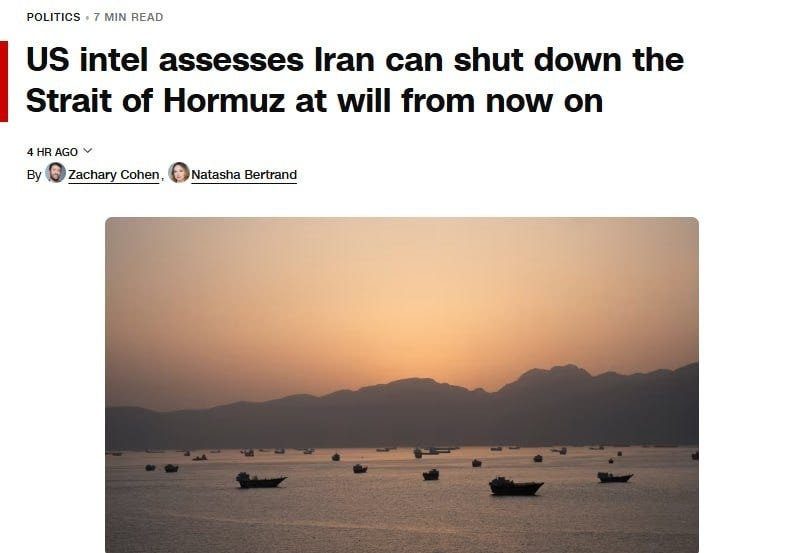
From the above:
US intelligence agencies have recently assessed that Iran can effectively shut down access to the Strait of Hormuz at will from now on, meaning the country’s regime has acquired a powerful new ability to hurt the global economy as a result of the war, according to three sources familiar with the findings.
Regardless of the framework agreement that is due to be formally signed on Friday to open the key waterway as a prelude to nuclear talks, Iran proved it can shut off access to the strait during the current conflict and US intelligence assessments suggest that could happen again.
In effect, Iran emerges with far more power, while the US emerges weakened beyond measure. Recall that virtually every US base in the region was either flattened or cleared out by Iranian strikes. Most have likely seen by now the BDA update to the radome in Bahrain which Iran blew away last week:


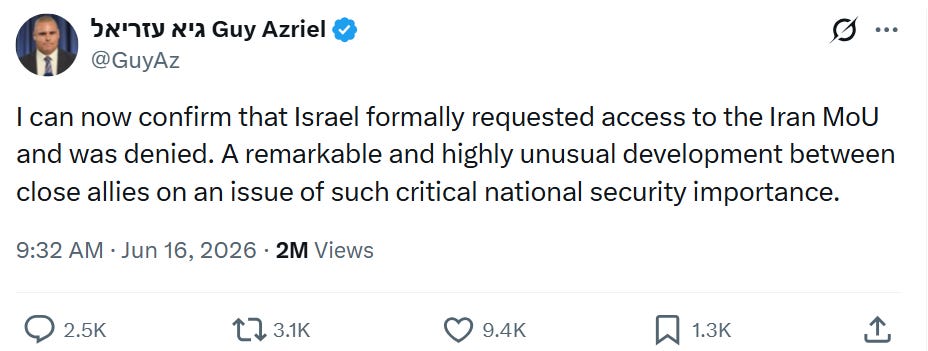
Now Iran has even achieved something else: creating a deeper fracture between the US and Israel. Trump was finally forced to scold Netanyahu several times over the Lebanon issue, with Trump’s approval rating in israel now diving overnight by a reported 23%.
Here, in a rare rebuke of Israel he admits that the colonialist state acted disproportionately in hitting Lebanon after a minor Hezbollah drone attack:
He still tries to put on a good face, but the reality appears that behind the scenes the fracture is deeper than he’d like us to believe.
Case in point, from an Israeli i24 News correspondent:
And as always, in the wake of the US’s capitulation we continue getting further inklings of the true extent of the disaster. For instance, FT has shed more light on how Iranian missile bases were able to weather the storm and continue firing even after being hit endlessly by munitions:
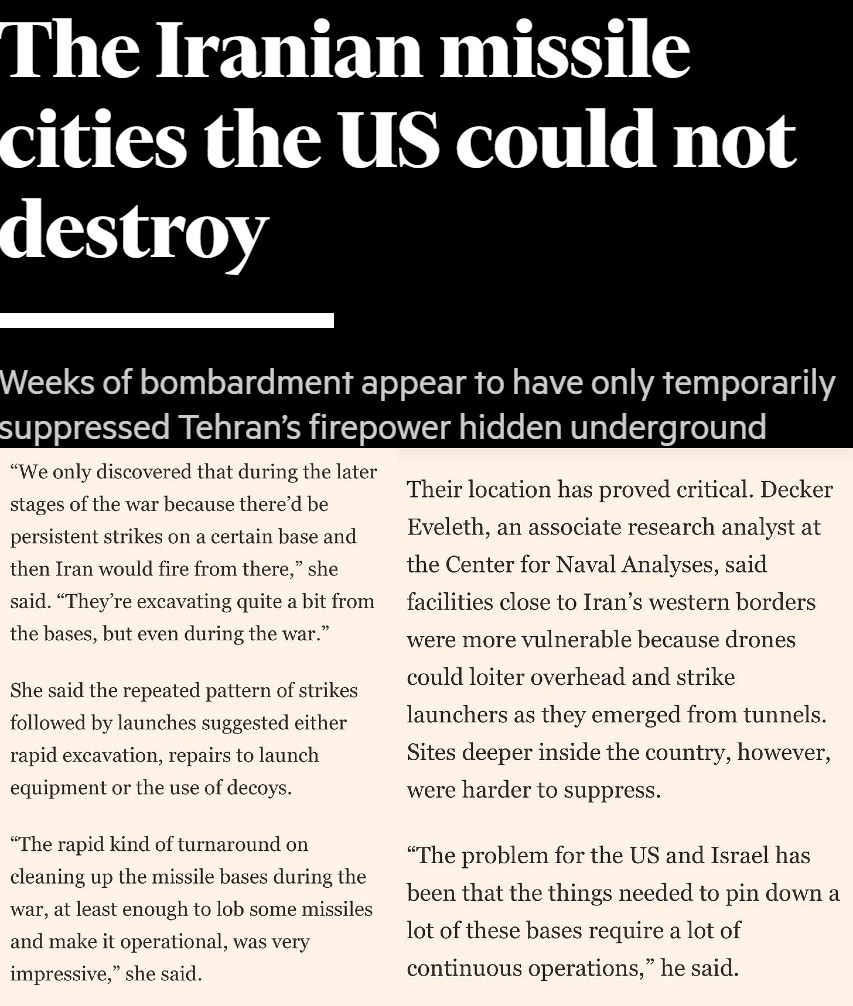
For 40 days, US and Israeli aircraft pounded the mountains around Yazd, trying to silence one of Iran’s most important military projects: a buried missile complex carved deep into the granite above the ancient desert city.
Yet, according to residents, the Iranian missiles kept firing regardless. “US and Israeli forces kept bombing those mountains,” said one resident of Yazd. “And Iran kept launching missiles until the final moments before the ceasefire.”
“The resilience of Iran’s underground “missile cities” has become one of the most significant and contested questions in the aftermath of the US-Israeli bombardment earlier this year.”
Iranian officials even stated that many of their missile cities did not even need to be tapped during the war because the US and Israel failed to put a significant enough dent into the main operational ones being used:
A second person close to the Islamic regime argued the depth of many sites rendered them largely immune to conventional aerial bombardment. He said some were not even used during the war because numerous other facilities remained operational.
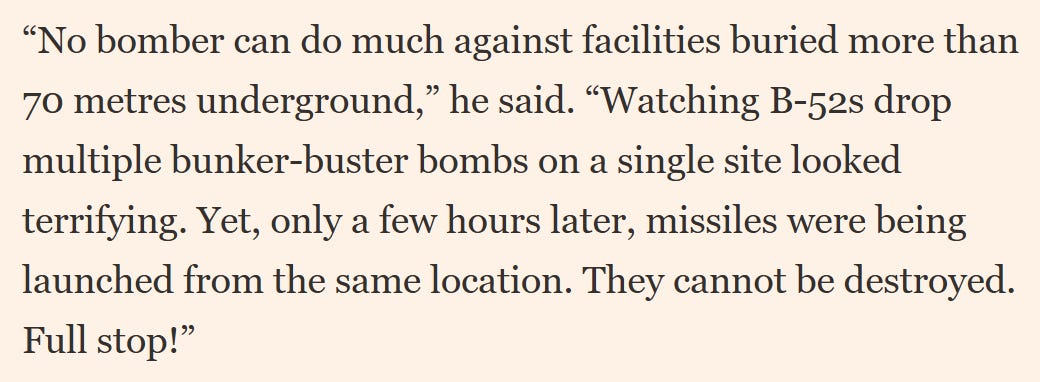
The article recounts how Iran’s former head of the missile forces, Amir Ali Hajizadeh, visited North Korea and drew lessons from its underground missile siloes, realizing that by utilizing such a tactic Iran wouldn’t require few air defenses as enemy aircraft simply have nothing to bomb because all the important infrastructure is so far underground. Recall how many times I said this at the start of the war: specifically, that Iran could simply withdraw its flagship air defense and other systems to the far east of the country to keep them safe because US-Israel would have nothing to bomb—everything had been squirreled away underground, and it wouldn’t even much matter if “air superiority” was truly established. Without ground troops conquering Iranian cities, the US could do nothing but bomb empty desert—or civilians, which only works in Iran’s favor as it leads to massive societal solidarity against ‘the Great Satan’.
Hilariously, Trump continues to waffle on the issue of Iran’s “nuclear dust”—which he deemed so important as to be a key reason for the launching of the entire war. Now in two new interviews, Trump backtracks by claiming that the nuclear dust is “harmless” and pretty much worthless:
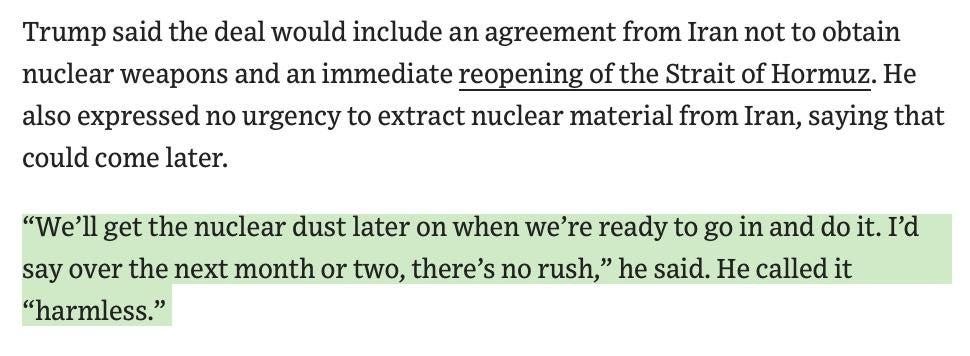
Listen below, as he says the “dust” is actually “not very valuable”, but is only important for “psychological” reasons:
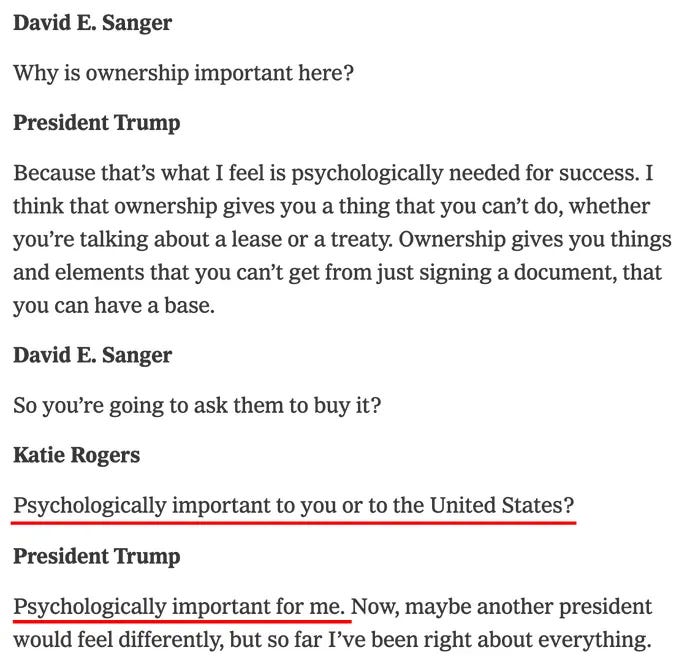
Trump seems to make a lot of massive geopolitical blunders for reasons of personal “psychology”. On the issue of ownership of Greenland, Trump once admitted he only wanted it because it was “psychologically important” to him:
Will this new “peace deal” and memorandum last? Likely not if Israel has anything to say about it. Netanyahu and his cronies have already announced that Israel will not be withdrawing from Lebanon and have strongly hinted that they will refuse to honor Hezbollah and Lebanon’s inclusion in the deal.
Iran’s own Khorasan paper claims that the peace deal is only postponing the apocalyptic “final battle” which awaits:
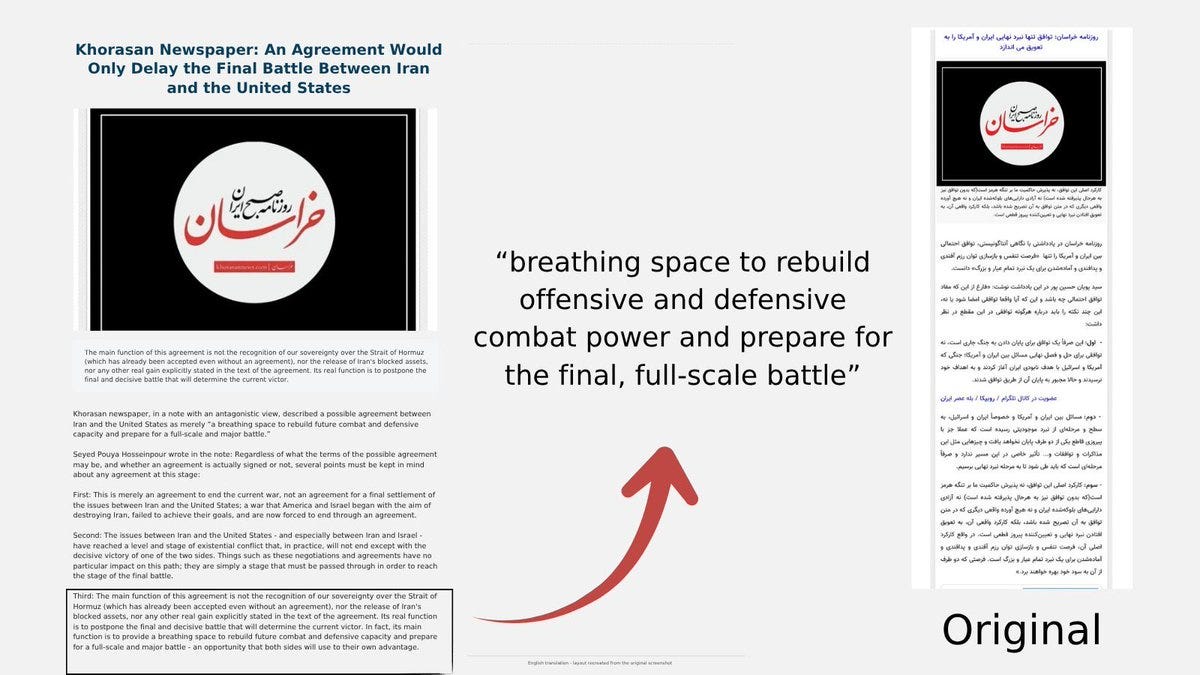
Transcription of the above:
The main function of this agreement is not the recognition of our sovereignty over the Strait of Hormuz (which has already been accepted even without an agreement), nor the release of Iran’s blocked assets, nor any other real gain explicitly stated in the text of the agreement. Its real function is to postpone the final and decisive battle that will determine the current victor.
Khorasan newspaper, in a note with an antagonistic view, described a possible agreement between Iran and the United States as merely “a breathing space to rebuild future combat and defensive capacity and prepare for a full-scale or major battle.”
Seyed Pouya Hosseinpour wrote in the note: Regardless of what the terms of the possible agreement may be, and whether an agreement is actually signed or not, several points must be kept in mind about any agreement at this stage:
First: This is merely an agreement to end the current war, not an agreement for a final settlement of the issues between Iran and the United States; a war that America and Israel began with the aim of destroying Iran, failed to achieve their goals, and are now forced to end through an agreement.
Second: The issues between Iran and the United States, and especially between Iran and Israel — have reached a level and stage of existential conflict that, in practice, will not end except with the decisive victory of one of the two sides. Things such as these negotiations and agreements have no particular impact on this path; they are simply a stage that must be passed through in order to reach the stage of the final battle.
Third: The main function of this agreement is not the recognition of our sovereignty over the Strait of Hormuz (which has already been accepted even without an agreement), nor the release of Iran’s blocked assets, nor any other real gain explicitly stated in the text of the agreement. Its real function is to postpone the final and decisive battle that will determine the current victor. In fact, its main function is to provide a breathing space to rebuild future combat and defensive capacity and prepare for a full-scale and major battle — an opportunity that both sides will use to their own advantage.
It’s hard to argue the above prognostication.
And this conclusion is a fitting end point, as well:
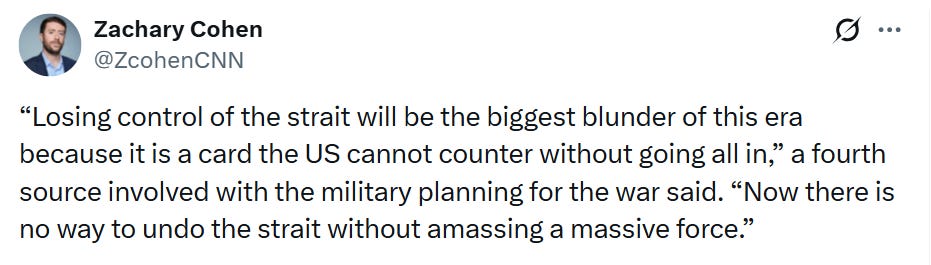
The US lost a major portion of its reconnaissance fleet via the destroyed Reaper drones, lost a huge swath—perhaps even the majority—of its regional long-range detection radars; essentially, it lost its eyes and ears. Additionally, the US’s feared “carrier fleets” turned out to be nothing more than empty bogeymen, broken-down hulks which drifted aimlessly out of reach of Iran’s coastal defense batteries.
The same goes for the feared “US Marines” which did nothing more than sit idle aboard the Tripoli off the coast of Oman, attempting to cow Iran into submission with their mere presence, instead exposing all the US’s most powerful tools of leverage and coercion as having lost all their historical factors of intimidation.
Your support is invaluable. If you enjoyed the read, I would greatly appreciate if you subscribed to a monthly/yearly pledge to support my work, so that I may continue providing you with detailed, incisive reports like this one.
Alternatively, you can tip here: buymeacoffee.com/Simplicius
Iran is Unbowed, Unbent, Unbroken.
Ther reality is a bit different.
1) None of the positive for Iran things in the MoU are firm guarantees with precises conditions and deadlines. And nobody has any intention to do those things anyway, they will remain empty promises
2) The US has not been physically removed from near Iran. Which was a mandatory outcome for Iran out of this war. But the bases are still there. They had to be pushed back at least 1500 km so that they cannot launch mass swarms of kamikaze drones the way they are doing to Russia now.
3) Zero deterrence has been imposed. Iran's leadership has been killed, Trump is alive, Hegseth is alive, Netanyahu is alive, etc. It was absolutely mandatory to take out Trump and Netanyahu at the very least to reimpose some deterrence. And to go after soft targets such as the Jewish billionaires in their mansions and yachts. Lots of ways to do that. But it wasn't done.
4) They didn't sink any US ships and thus neither the massacres of civilians such as Minab, nor the cowardly sinking of the Iranian ship near India, have been avenged.
5) Hit-and-run has in fact been normalized. Sure, Iran "responds", but not in a way that reenforces deterrence
6) The US is getting six months to retool and will resume the war after the midterms. Meanwhile it is already perfecting TEL hunting techniques in Russia through Starlink and kamikaze drones, i.e. next time it will not be relying on expensive MALE drones to do it and will suppress Iranian launches much more effectively.