

Ukraine's SPIEF Attack Aims for Max Provocation, as Drones Witnessed Coming From Baltic Direction

Ukraine launched a major drone attack on Russia’s St. Petersburg to coincide with the annual St. Petersburg International Economic Forum (SPIEF). The purpose was obviously to humiliate Russia in front of its many international attendees, which included US State Department personnel and foreign dignitaries.
Ukraine achieved its desired optics by casting the opening of the prestigious event under the pall of imminent threat, as attendees were forced to enter beneath clouds of billowing smoke from struck refineries:
The problem is, as is usual for Ukraine, the attacks were more style over substance, as satellite photos showed minimal damage to the St. Petersburg oil terminal despite a max effort by Ukraine:
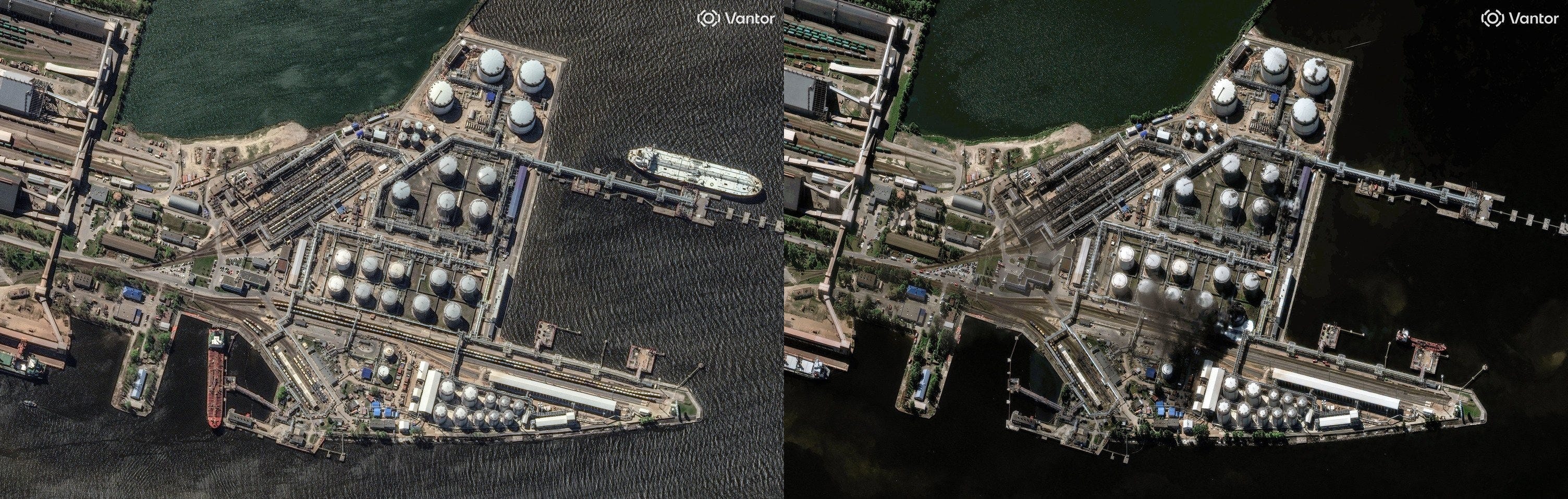
Vantor collected new imagery showing the aftermath of the Ukrainian drone attacks on an oil terminal in St. Petersburg, Russia.


Because the effect of burning oil is so overt and reads so well on camera, with plumes of black smoke seen from miles away, these types of attacks are used for maximum PR-boosts to drive narratives that Russia is finally on the “back foot”, or is outright collapsing. In reality, these past two weeks, Russia has regained all initiative on the battlefield, again advancing on virtually every single front, with daily settlement captures. Ukraine and its partners are writhing in agony, hatching various plans to “meet Putin” in order to “settle the war by the year’s end”, as Zelensky suddenly appears desperate to do; there is a reason for that.
At the SPIEF, Putin exuded confidence:
The Russian Armed Forces are advancing along the entire line of contact; there is no sector where Russian troops are not on the offensive.
Over the recent period, the strength of the Ukrainian Armed Forces has decreased by 100,000 personnel, with monthly losses amounting to approximately 40,000.
Forced mobilization in Ukraine amounts to approximately 15,000–16,000 people per month.
Around 20,000 people desert from the Ukrainian Armed Forces every month; according to Putin, nobody wants to fight.
Recently, the Russian army has brought approximately 2,400 square kilometers of territory under its control.
Russia controls more than 85% of the territory of the Donetsk People’s Republic (DPR), 100% of the Luhansk People’s Republic (LPR), and 80% of the Zaporizhzhia region.
But the major controversy came over mounting evidence that Ukraine may be using the airspaces of third countries to strike these far north Russian regions. Several pieces of data seemed to point to this in the new strikes.
For instance, Estonia had many drone alerts issued during the strikes, but they appeared to be contained to eastern counties bordering Russia. There was a lot of misinformation circulating, including maps that appeared to show western counties, like Lääne County seen here, as part of the alerts:
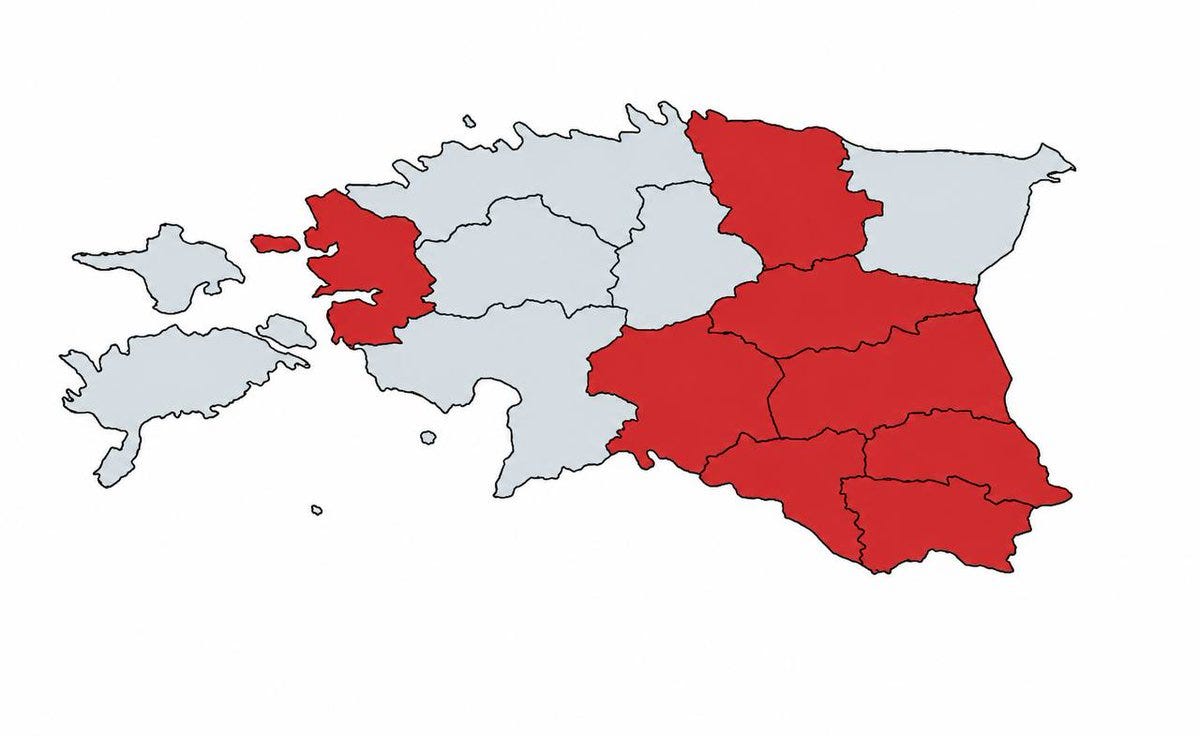
My cursory research shows the western-most Lääne County bordering the Gulf of Finland and Baltic Sea was not in fact part of the alerts.
Some pro-Ukrainian analysts believe the flight path simply skirted the western-most borderlands of Russia as follows:


A mock-up map from the above post:
But there was a claimed “smoking gun” which showed a drone said to be the Ukrainian FP-1 skimming the waters of the Baltic Sea en route to either Kronshtadt or St. Petersburg:
Virtually nothing is confirmed about the video above, but we can deduce a few things. Firstly, the attack happened in morning, so the low sun visible in the video must be in the eastern direction. Given the drone’s trajectory, we can therefore deduce it is traveling in a roughly north-south vector, given that it’s not heading either toward (east) or away (west) from the sun’s direction, but rather perpendicular to it.
Further, given that the sailors in the video are speaking Russian, we can perhaps assume the ship is floating in Russian territorial waters. Given that land is visible in the direction of the sun (east) but no cityscape (St. Petersburg) is visible, it would imply the ship is filming perhaps somewhere here, though these are very rough deductions—feel free to share your own theories:
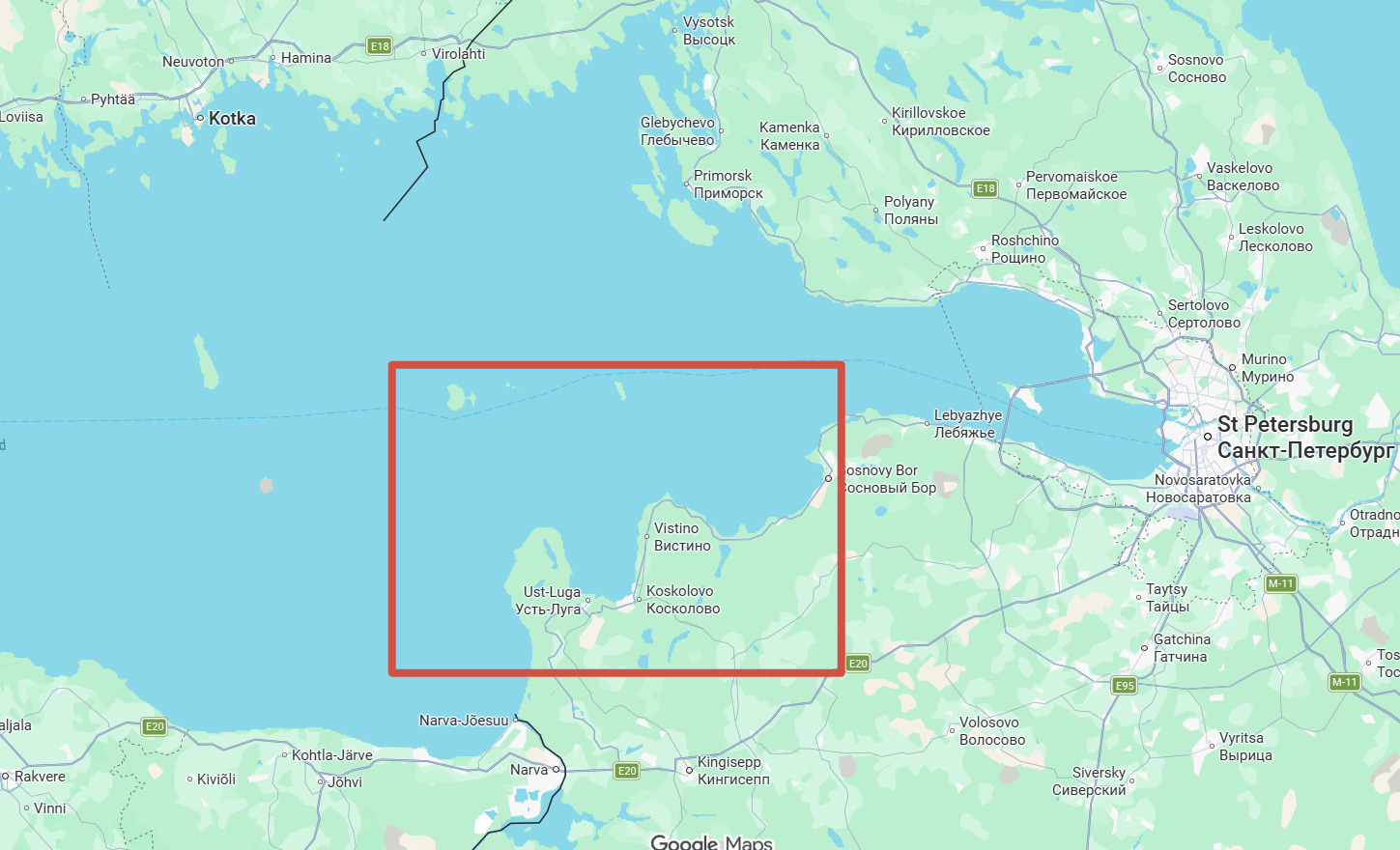
Recall that we have no real confirmation the object in the video is in fact Ukrainian, though it can be assumed to be the case. One theory is that Ukrainian missiles could simply fly out to sea to change their directions, which Russian missiles and drones commonly do when hitting Ukraine.
For instance, Ukraine could assume that most of St. Petersburg’s defenses are pointed toward the southerly direction, which means some of them could be bypassed—in theory—by coming from the west, northwest, or north. Thus, such a missile could theoretically take a route as follows without need of passing through the territories of Baltic countries:
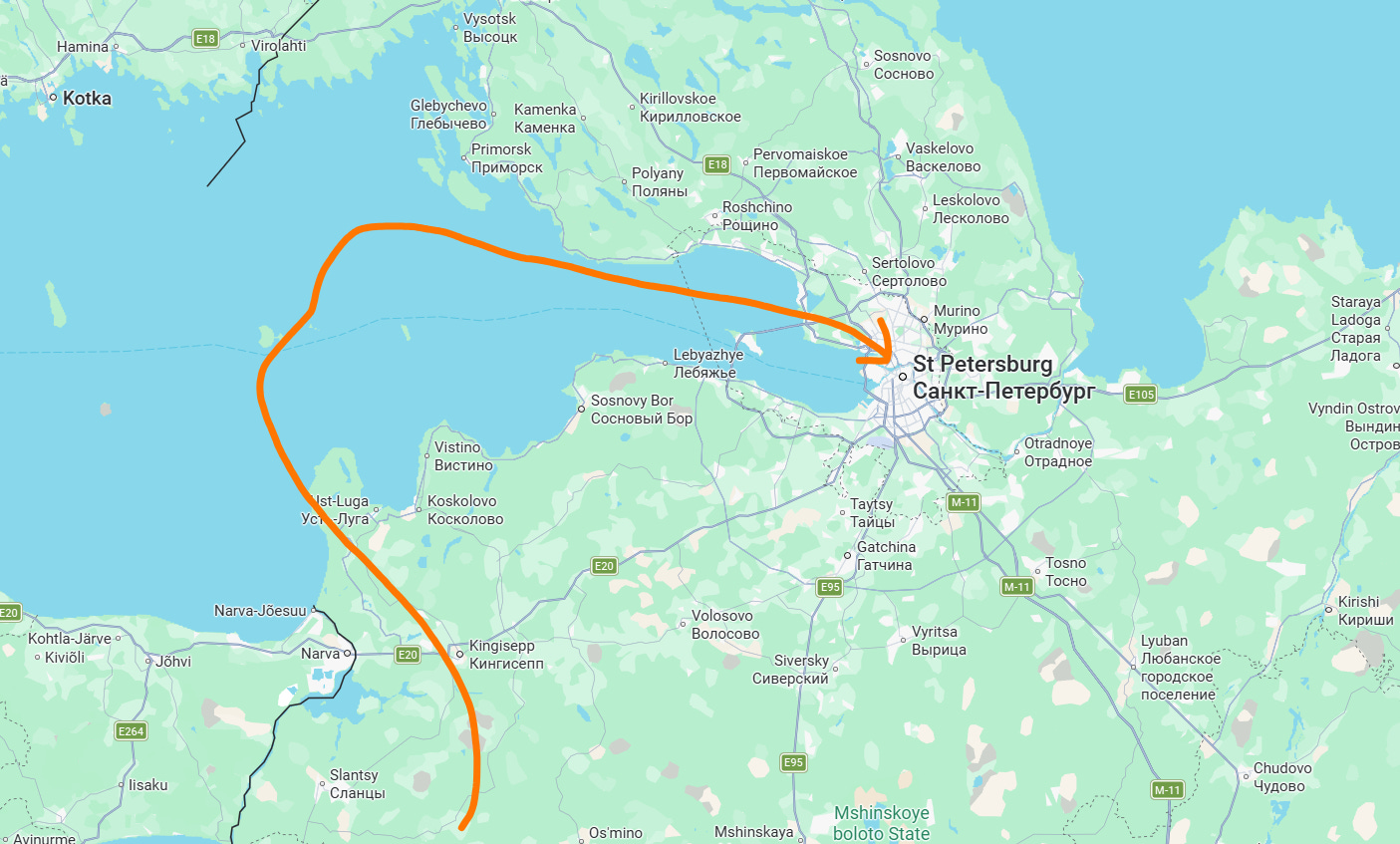
Such an approach would maximize the “stealth” afforded by the sea, by allowing the missile to skim the waters as low as possible to approach St. Petersburg from an oblique and unexpected angle.
Another example: a Ukrainian Lyuti drone which struck the St. Petersburg oil storage appeared to come directly from the western-northwestern direction:
The proof is that the Lakhta center is seen in the distance, and its orientation exactly matches photos from google maps taken from roughly where the oil terminal is, e.g.:
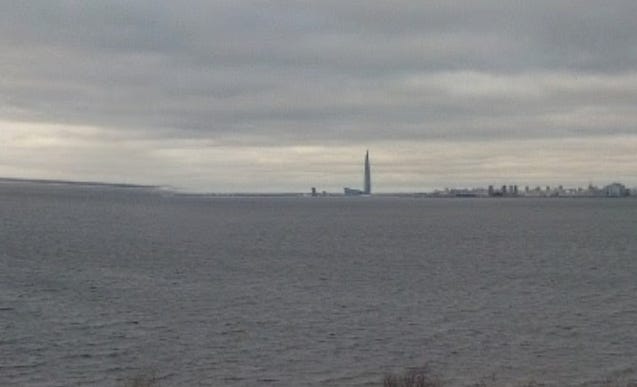
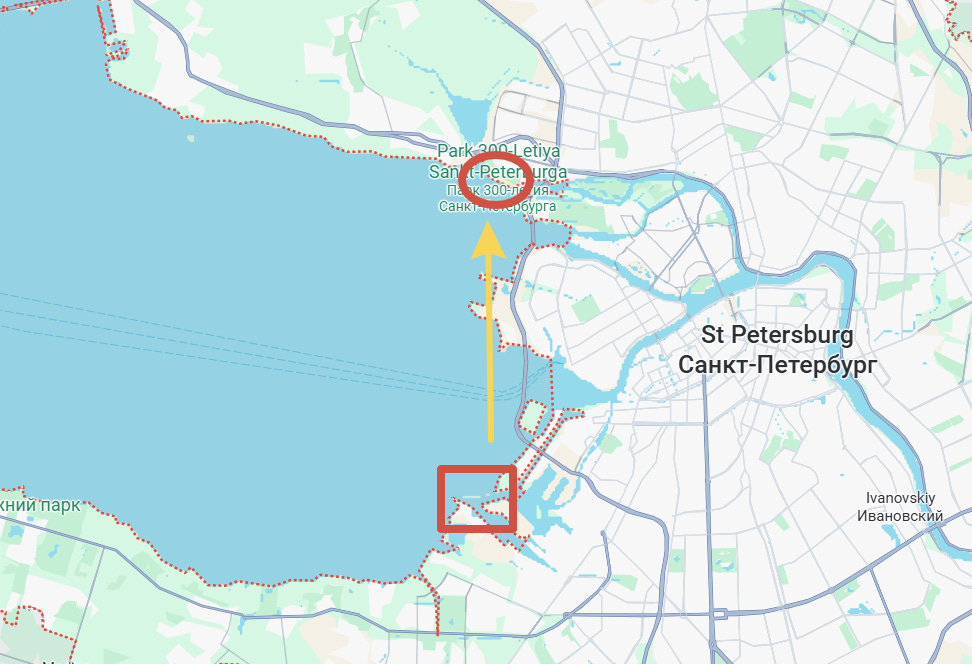
The orientation of this view is looking northward like so—the bottom square is the oil terminal, the top circle is the Lakhta center, and the yellow line is the camera’s directional perspective:
Now watch the video again—the drone is moving west to east against this axis:
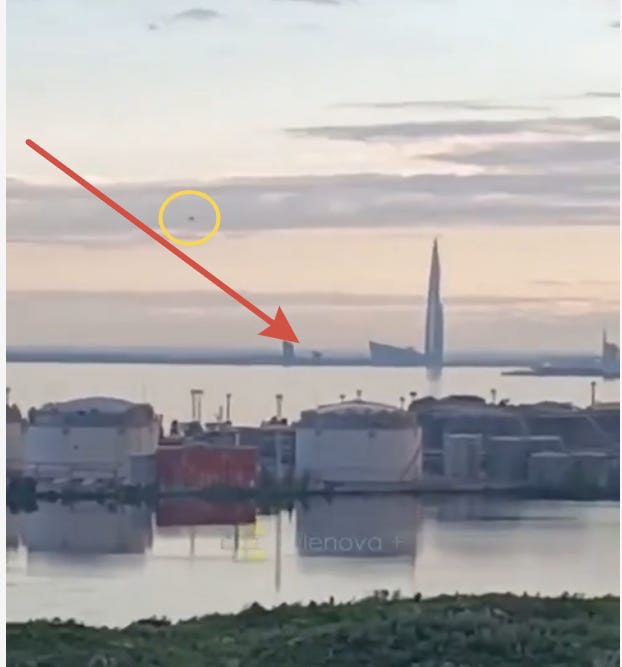
A Ukrainian drone flying directly from Ukrainian territory should be approaching St. Petersburg from the south, not the west-northwest. But as stated earlier, it is possible they were rerouted to circle around from the direction of the sea, though such an elongation of travel time would give Russia more time to shoot the projectiles down and thus perhaps make the strategy more improbable. But you decide, and share your thoughts.
That all said, the incident should still obviously be treated with great suspicion, particularly because NATO craft were seen all along Russia’s borders during the attacks, seemingly guiding the projectiles or mapping Russian air defenses along the routes.
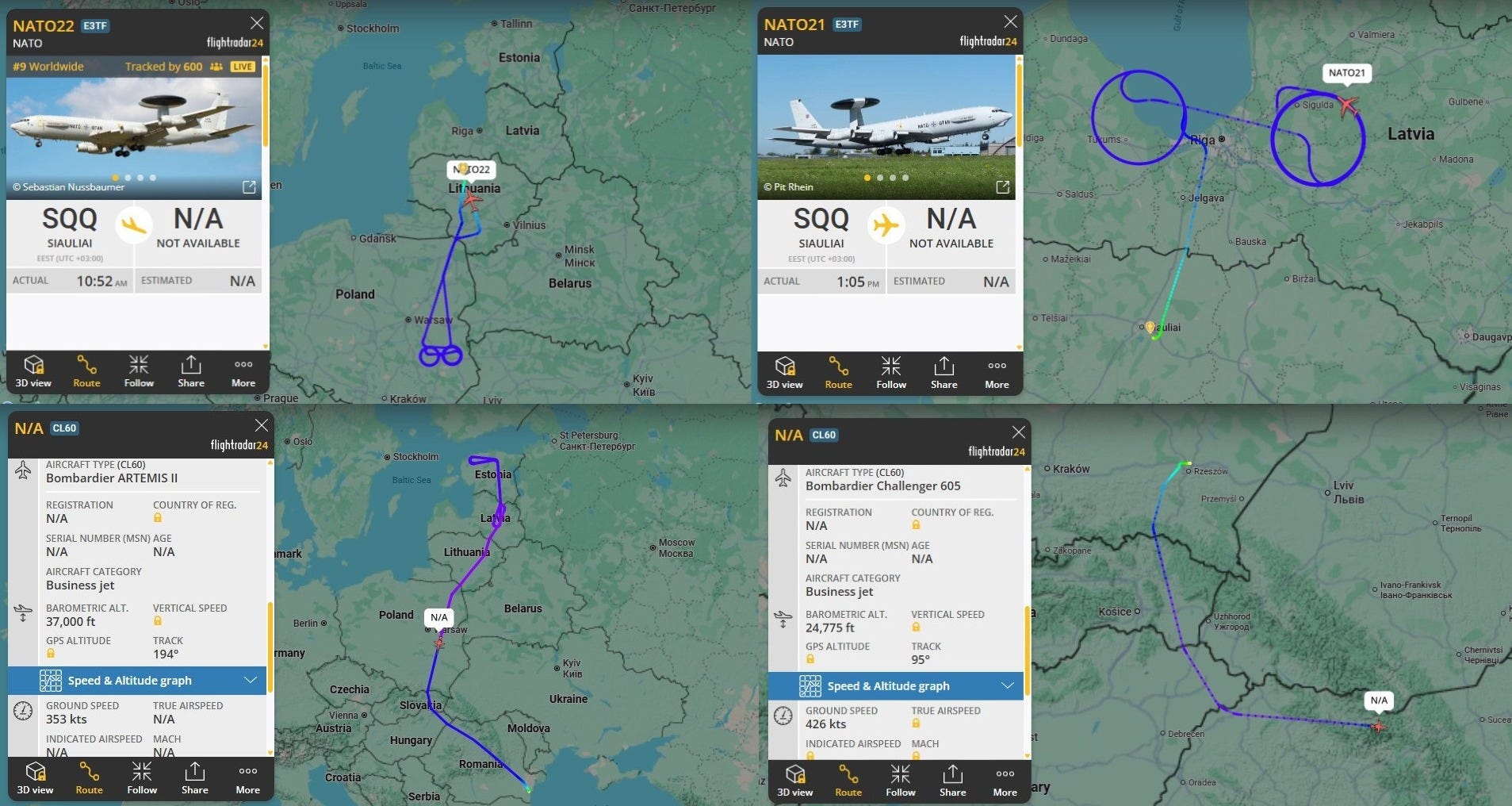
At this moment, extremely high activity of NATO’s air force reconnaissance aircraft is being recorded in the Kaliningrad, Belarus, and Pskov directions. A pair of E-3A Sentry AWACS aircraft are operating over Latvia and Lithuania, which, using AN/APY-2 radars, monitor the airspace of Russia and Belarus at a depth of 200 to 550 km - depending on the reflective surface of aerial objects.
Also, the presence of ARTEMIS strategic radio-technical and radio-electronic reconnaissance aircraft is being recorded in the airspace of Poland and Romania. Their crews are detecting and classifying radio-emitting sources (including the 96L6, 92N6, and RML SOC radars of the S-400 and Pantsir-S1M systems, as well as radar means of other air defense systems). It is obvious that this information, in conjunction with data from ICEYE radar reconnaissance satellites, will be processed by AI algorithms and then transmitted to such combat control and strike analysis points as Prisma. Therefore, the likelihood of the enemy continuing attacks on targets in the Baltics is extremely high.
Notably, the reconnaissance activities currently being recorded are routinely attributed to the participation of reconnaissance aircraft in the BALTOPS 26 exercises.
A Swedish Air Force S102B Korpen electronic reconnaissance aircraft monitored all operations of the Russian air defense, engaged in repelling yesterday's “Ukrainian” UAV raid on St. Petersburg.
For the record, Rybar likewise attempted to map the strike crafts’ directions:
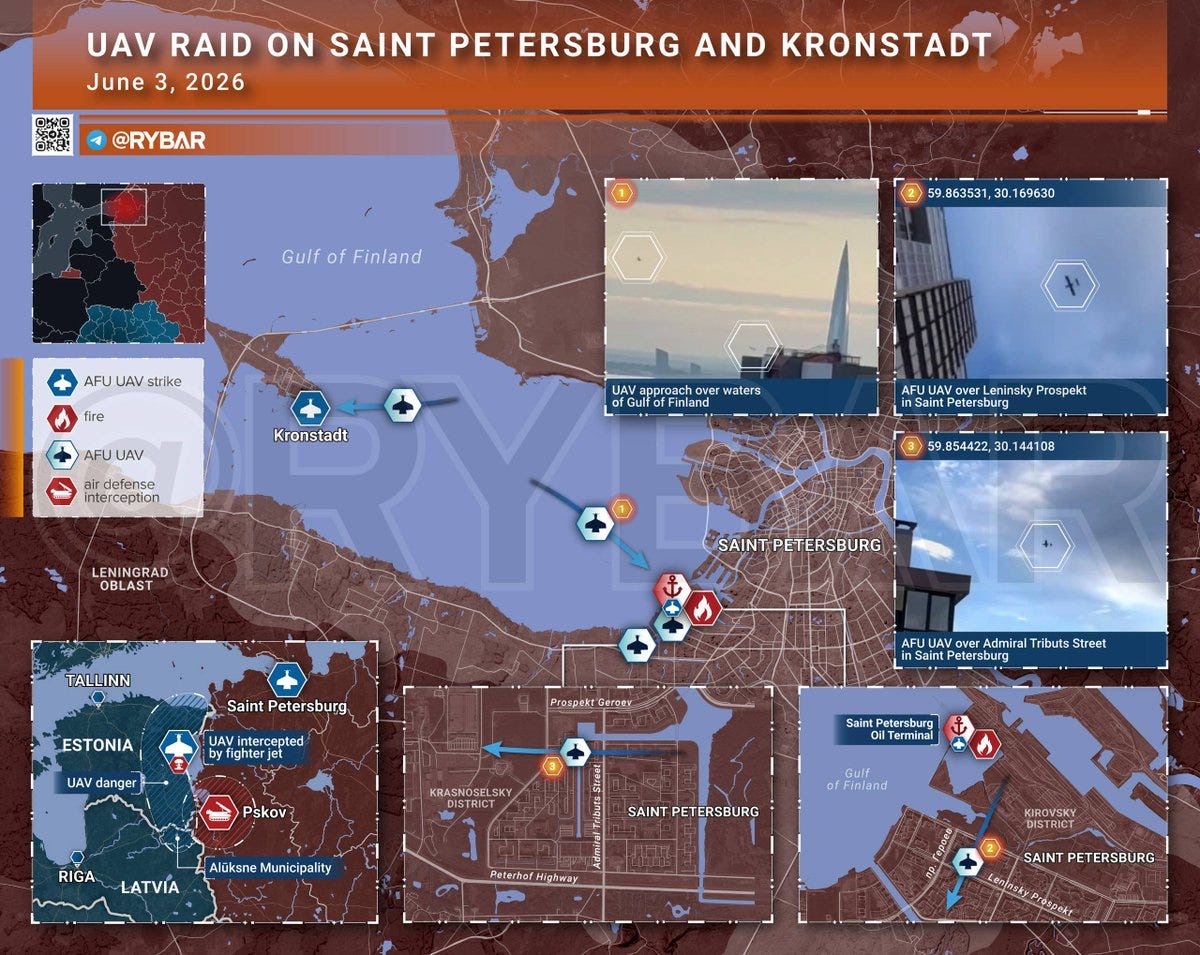
So, what do you think?
Stay tuned for a premium part two to this article that will go in depth on the crossroads moment Russia is nearing in light of these recent escalations, particularly should it be proven that European countries have been directly involved in aiding Ukraine’s recent spate of successful drone strikes.
Your support is invaluable. If you enjoyed the read, I would greatly appreciate if you subscribed to a monthly/yearly pledge to support my work, so that I may continue providing you with detailed, incisive reports like this one.
Alternatively, you can tip here: buymeacoffee.com/Simplicius
When NATO aircraft gather data during an “AFU” drone attack, what they are doing is trying to make the *next* attack more effective. So maybe Russia should treat this kind of surveillance as an act of war and start reacting accordingly.
PR. It's always just PR. Russia cannot stop the attacks. Hate to break it to you, but when the enemy can kill your people and disrupt life in your major cities at will, that's no longer a public relations stunt, but a sign of your impotence.
You can't wave these things away as PR anymore. Imagine drones casually descending on Wall Street or Washington, D.C. That would not be PR, but a sign that you're under siege and losing the plot, and the war.