

SITREP 7/2/26: Another Massive Strike on Kiev, as Konstantinovka on the Brink

Last night Russia again struck Kiev with one of the most massive attacks of the war, after having saved up missiles and drones for the past couple weeks.

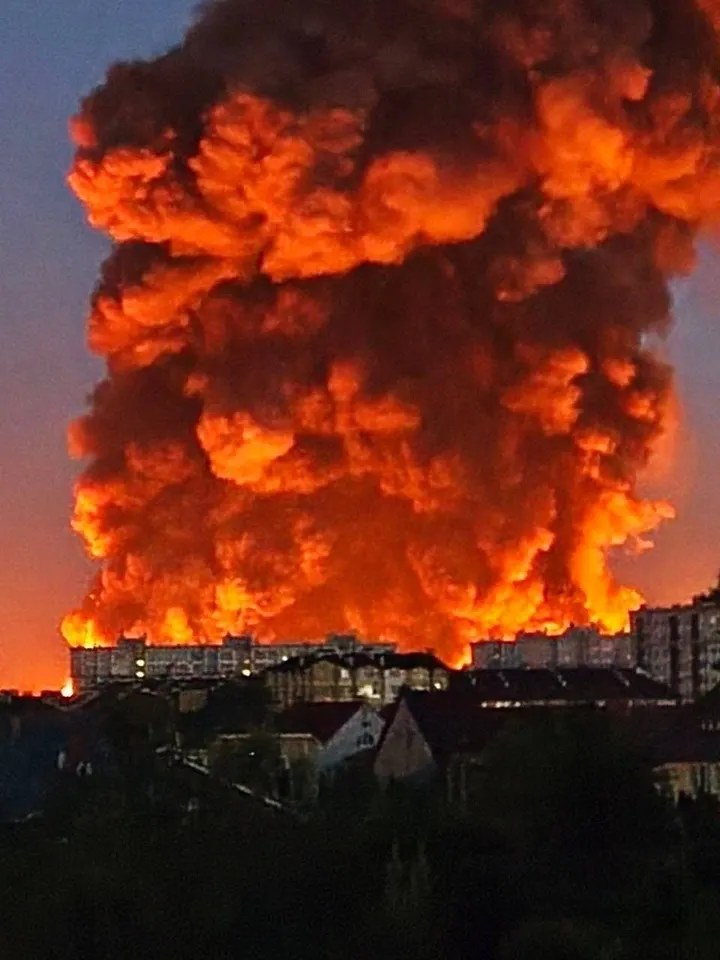


Many industrial enterprises were said to be hit amidst apocalyptic scenes. Judging by pro-Ukrainian pundits’ favorite heuristic, we are to assume that the size of the plume columns over the city means definitively that Ukraine is now losing and Russia is back in the driver’s seat. The teachings say so:

Rybar has conveniently summarized the targets:
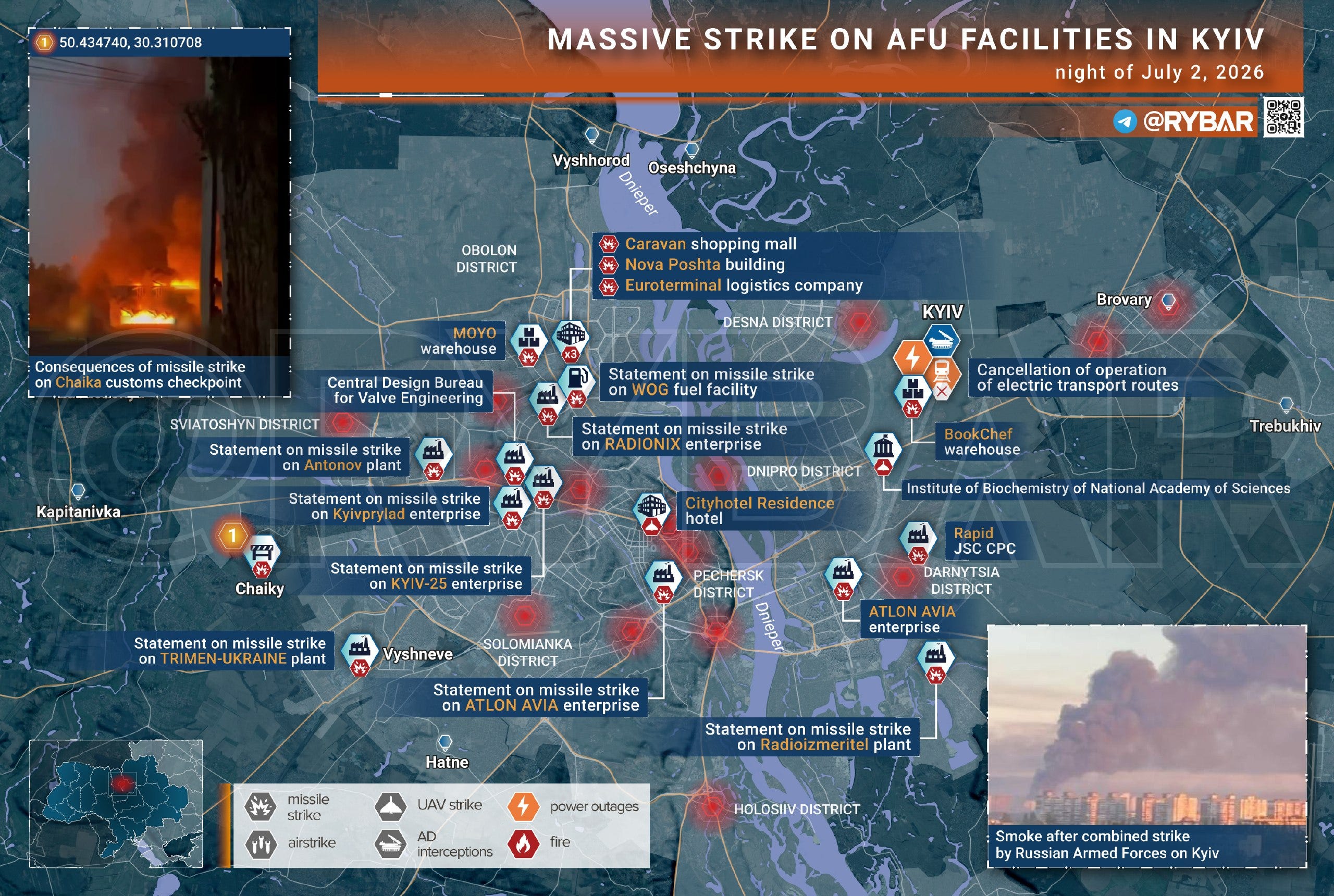
Today’s night strike on Kyiv aimed to hit key military-industrial plants, as well as logistics infrastructure facilities. In addition to this, strikes were also delivered against auxiliary infrastructure for the AFU, which became known thanks to footage of burning objects that emerged throughout the day.
➡️One of the major fires in Kyiv was recorded at the territory of the Chayka transport and logistics center. Its main importance for the AFU lay in the fact that its base was suitable for storing unmanned aerial vehicles, warheads and ammunition for them, as well as components for weapons and equipment arriving from abroad.
🔻What else was hit?
▪️Institute of Biochemistry of the National Academy of Sciences in Dniprovsky District of Kyiv.
▪️A branch of “Nova Poshta” in Obolon District. The organization has long worked in the interests of the AFU, helping to supply their formations on the front and even participating in the delivery of armored vehicles.
▪️A warehouse of the OKWINE alcohol store chain was destroyed, damage was recorded at the Kyivpryladok plant (which was previously reported by the Russian Ministry of Defense and is now confirmed by photographs) and several other warehouses of major companies.Hits were also recorded on the Taryan Towers business complex. According to some reports, real estate registered under proxy names there was used for housing SBU employees. One of the strikes hit the buildings of the CityHotel Residence and Premier Palace hotels, and Kyiv hotels have repeatedly housed foreign “specialists” and were used as temporary bases.
But the bigger story is that Russian forces have continued accelerating their territorial captures on the front to the point where it again begins to warrant our play-by-play analysis.
There have been several advances in key areas in the past few days which highlight broader strategic dilemmas for the AFU.
The first one was in the settlement of Kopani below, but Ukrainian accounts quickly refuted it, claiming to have recaptured the settlement shortly after and that Russia’s flag-planting there was merely a gimmick:
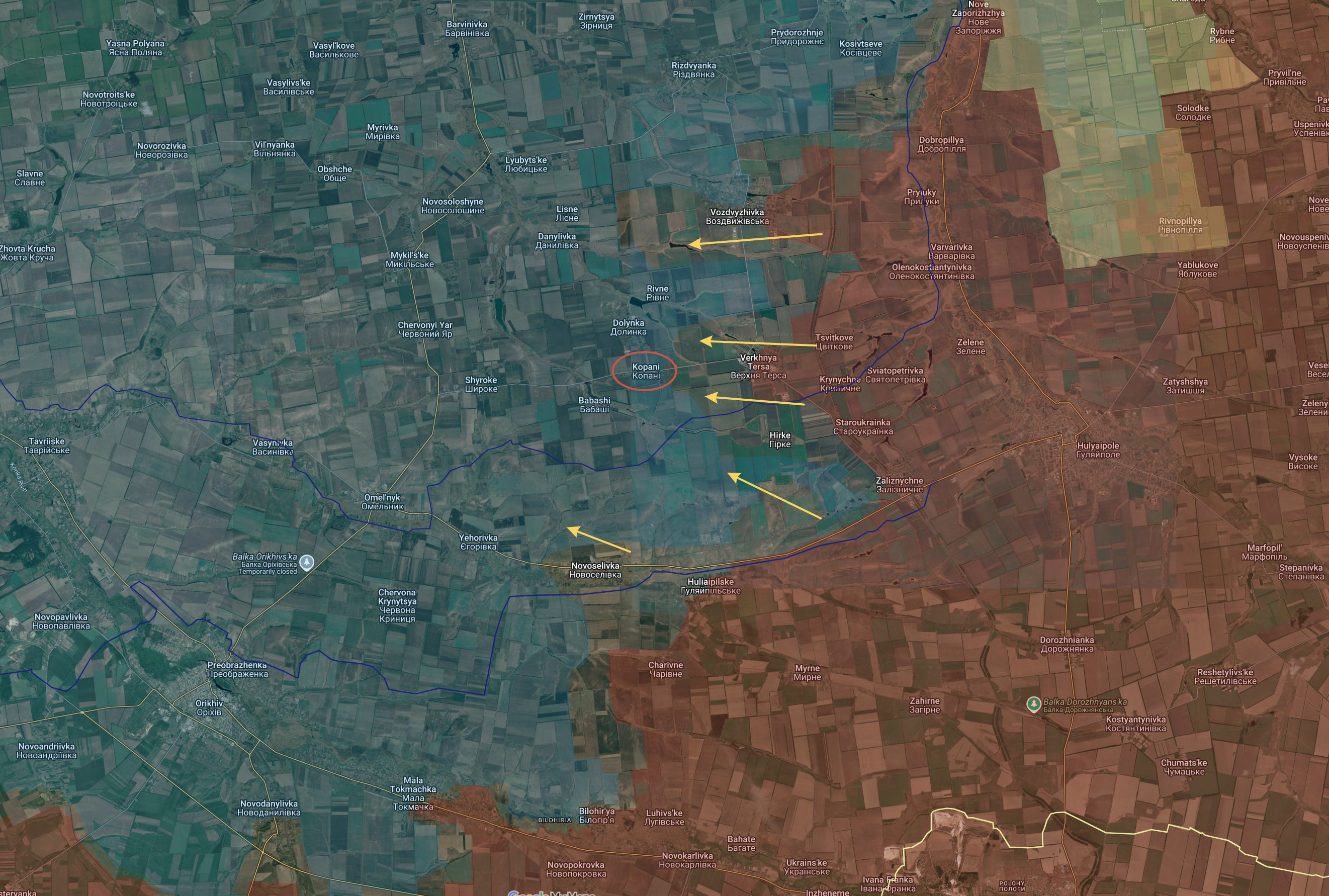
But we mention it anyway because Ukraine’s own “refutation” is not 100% trustworthy, and their own video of the “recapture” shows them first driving from somewhere far away in order to enter the settlement, which at minimum proves it’s in a gray zone not fully controlled by either party, though Russians are now obviously attempting to storm it.
Just northeast of there, Russian positions were clarified in Iskra, also called Andreevka Klevtsovo:
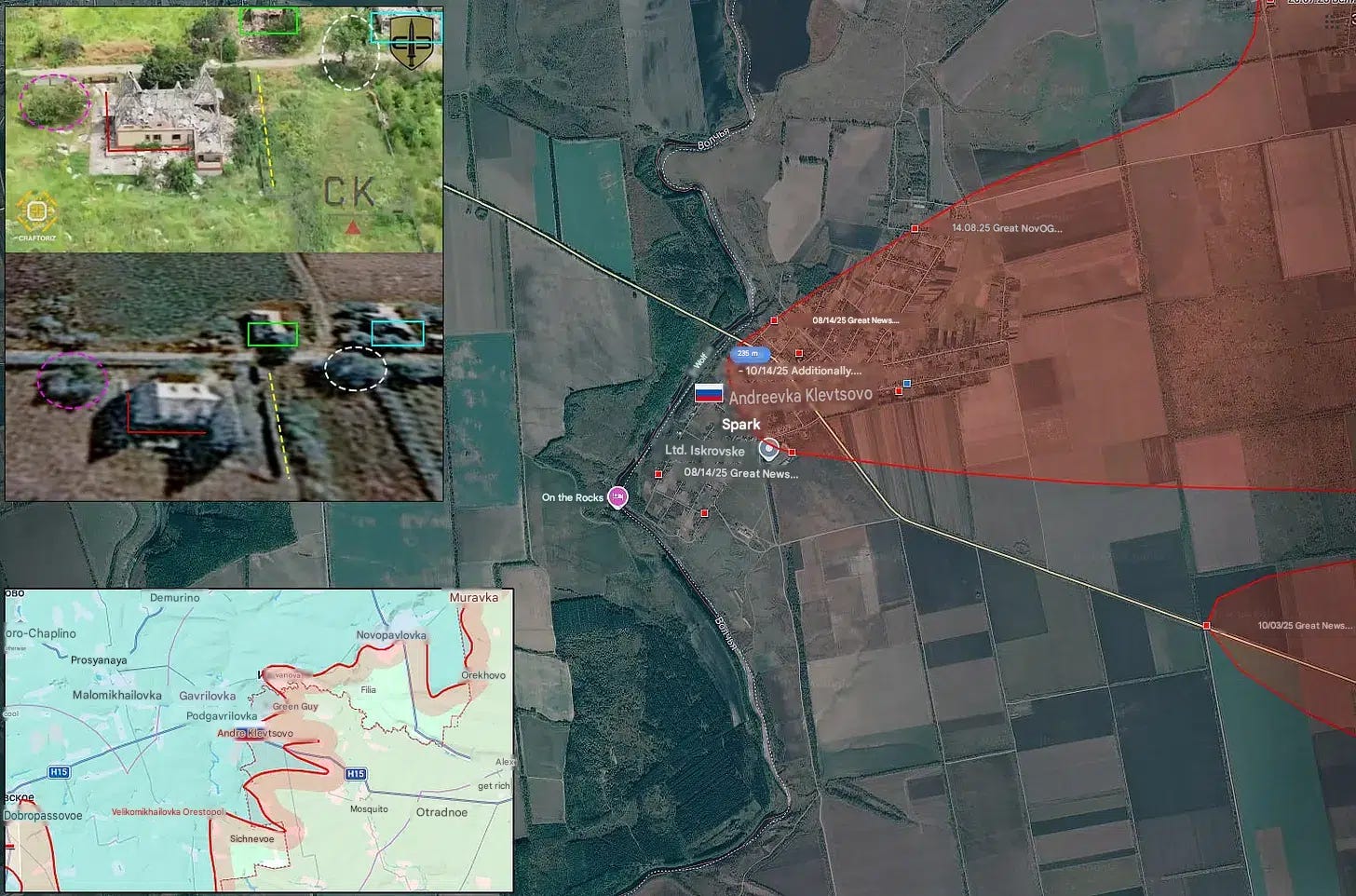
01.07.26 Velikaya Novoselka - Iskra
Positional combat actions in the area of Velikaya Novoselka.
Russian Armed Forces units are holding positions in the residential area of the settlement of Iskra under enemy fire. Clarification of the control zone of the Russian Armed Forces along the bank of the Volchya River.
Geolocation: 48.046976, 36.583177
The reason this is important is because as can be seen by the wider map below, the entire area there is colored as a kind of gray zone by mappers who are routinely uncertain of formal presences of troops. Given that Russian forces were confirmed at the very northernmost edge of this gray zone circled below is a good sign that implies much of that zone may actually be under Russian control:
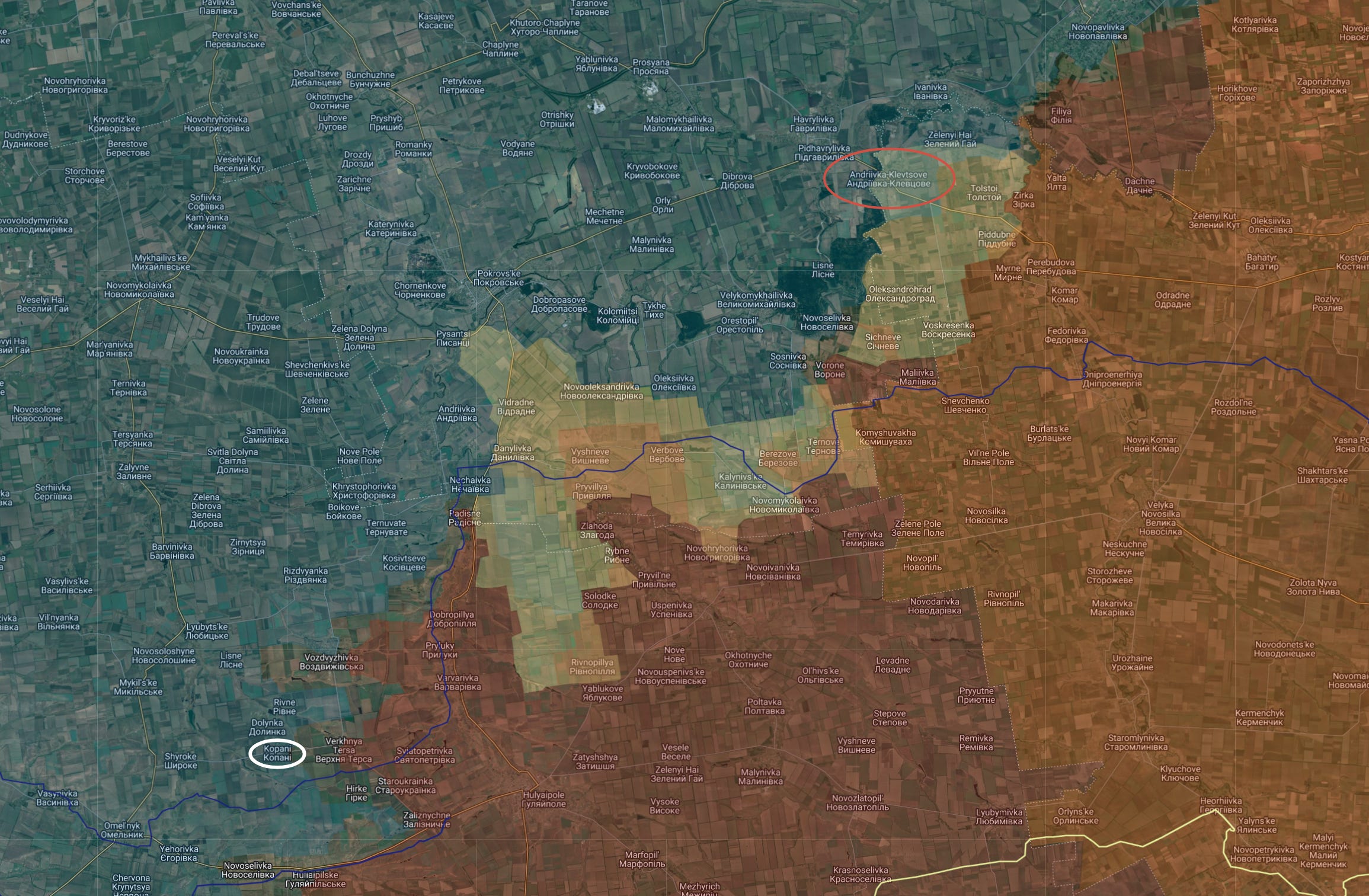
The earlier mentioned Kopani is seen circled in white at the bottom left of the map for reference.
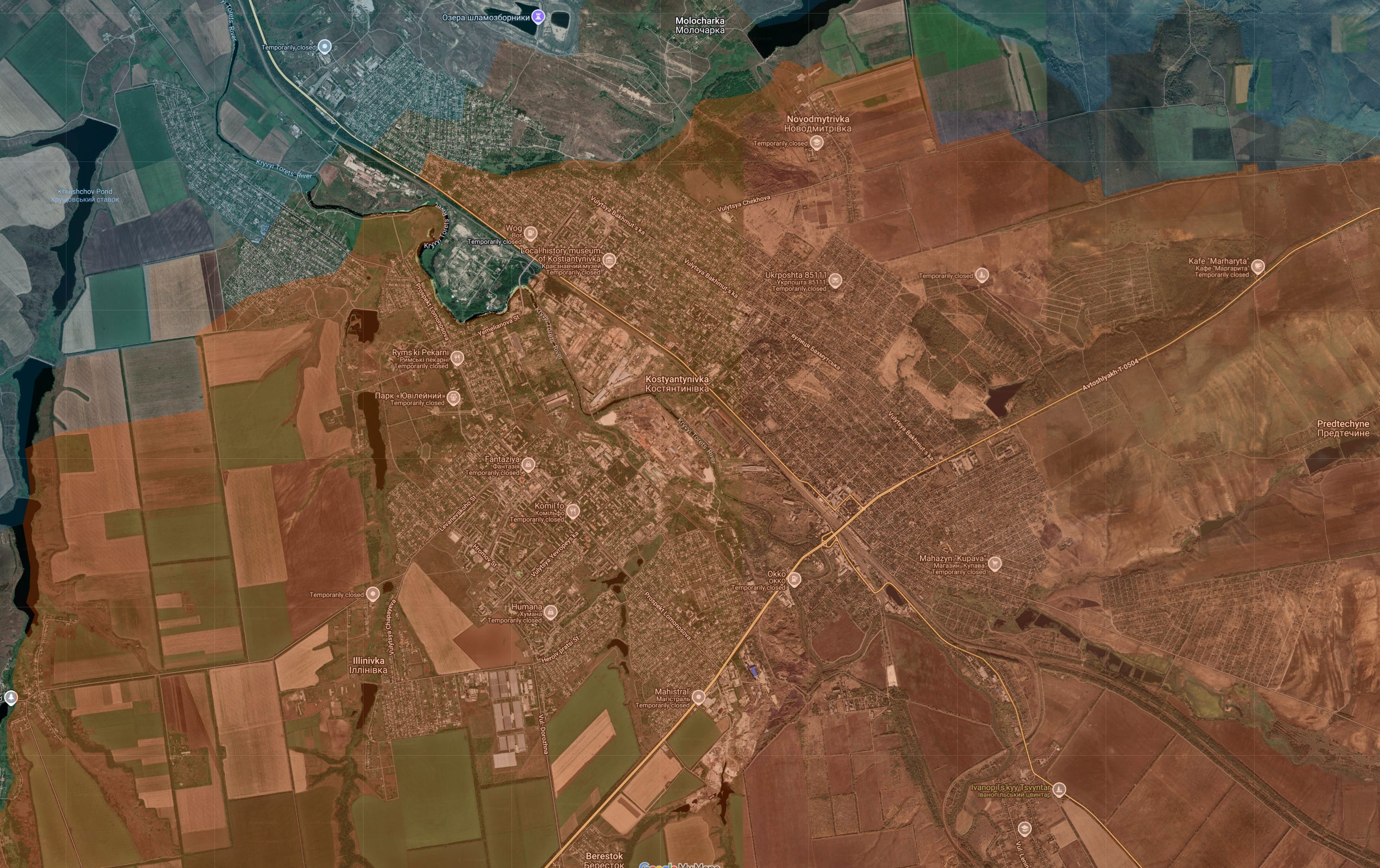
But more importantly, further northeast of there, Konstantinovka has been almost fully cinched up by Russian forces:
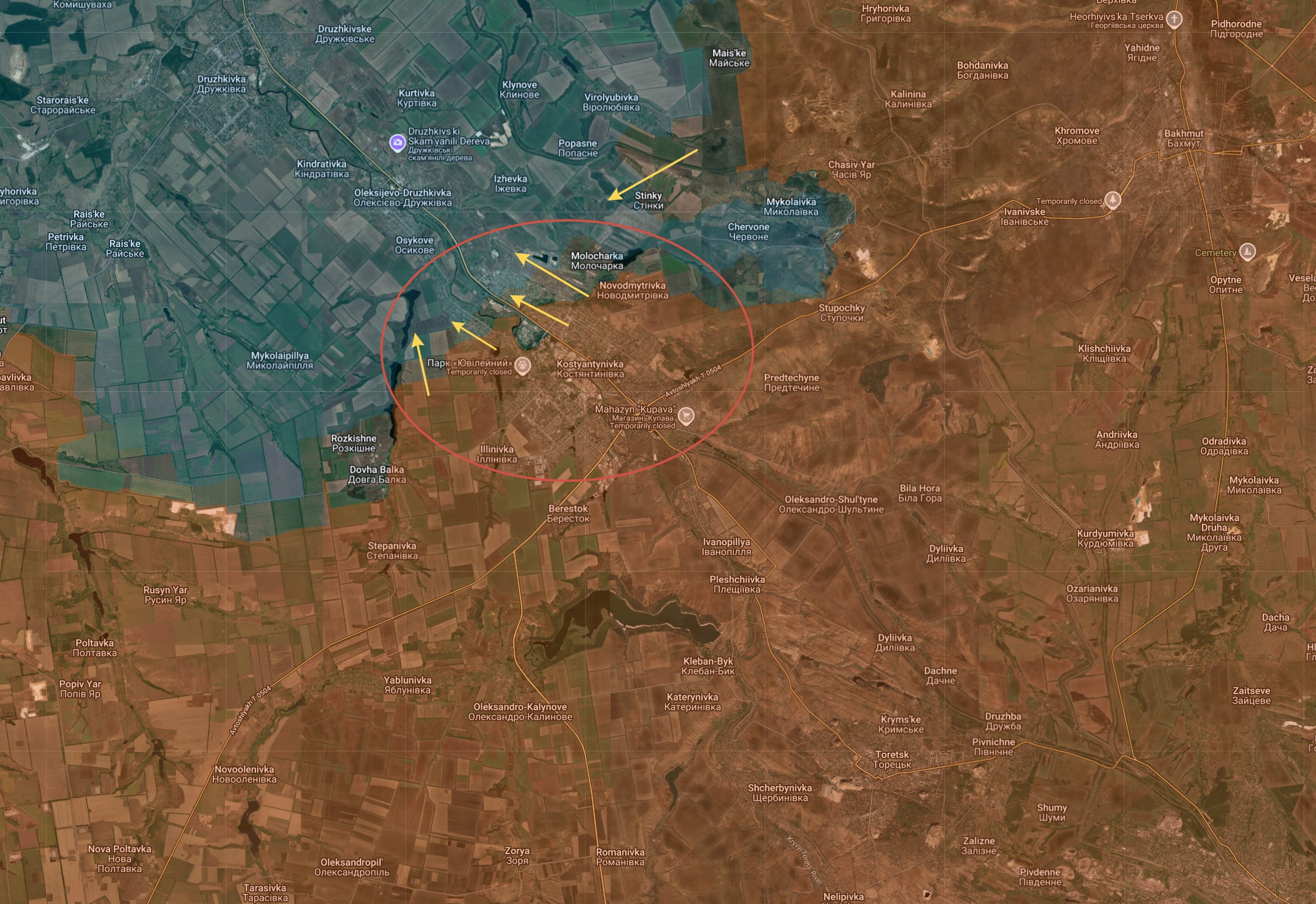
Closer view reveals only the northwestern-most district is still in Ukrainian hands:
The most the important front has become the combined Slavyansk-Kramatorsk region where Russian forces have been slowly pushing toward this final fortress agglomerate.
Suriyak notes several captures in the past few days highlighted in red below:
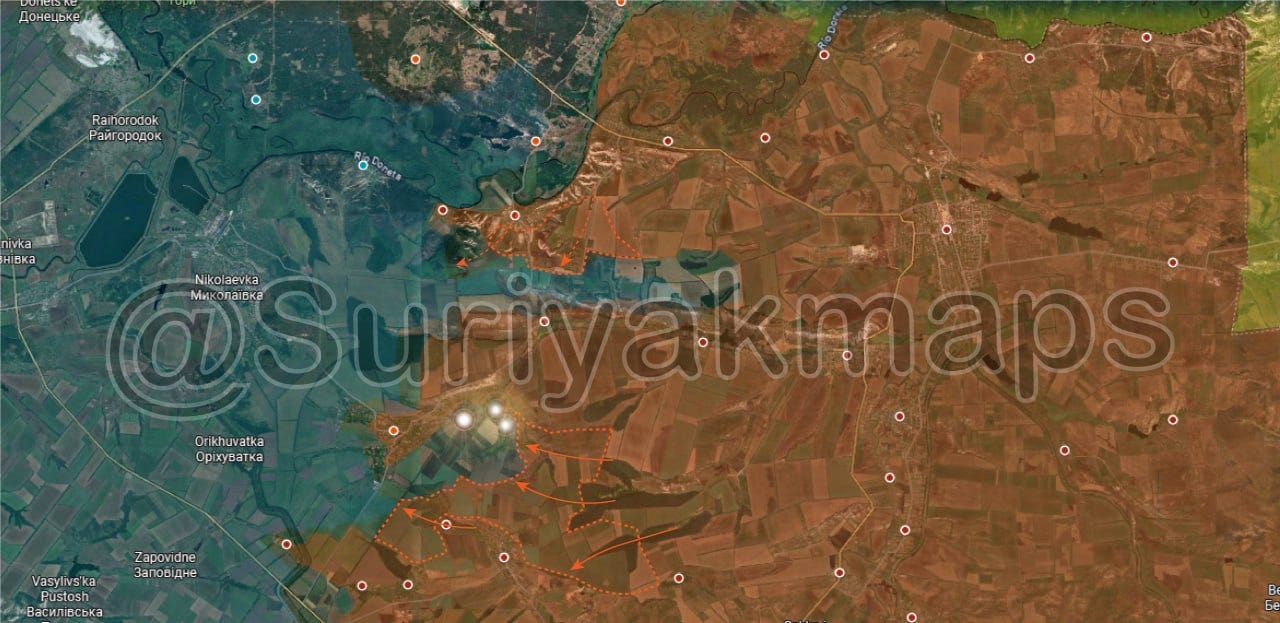
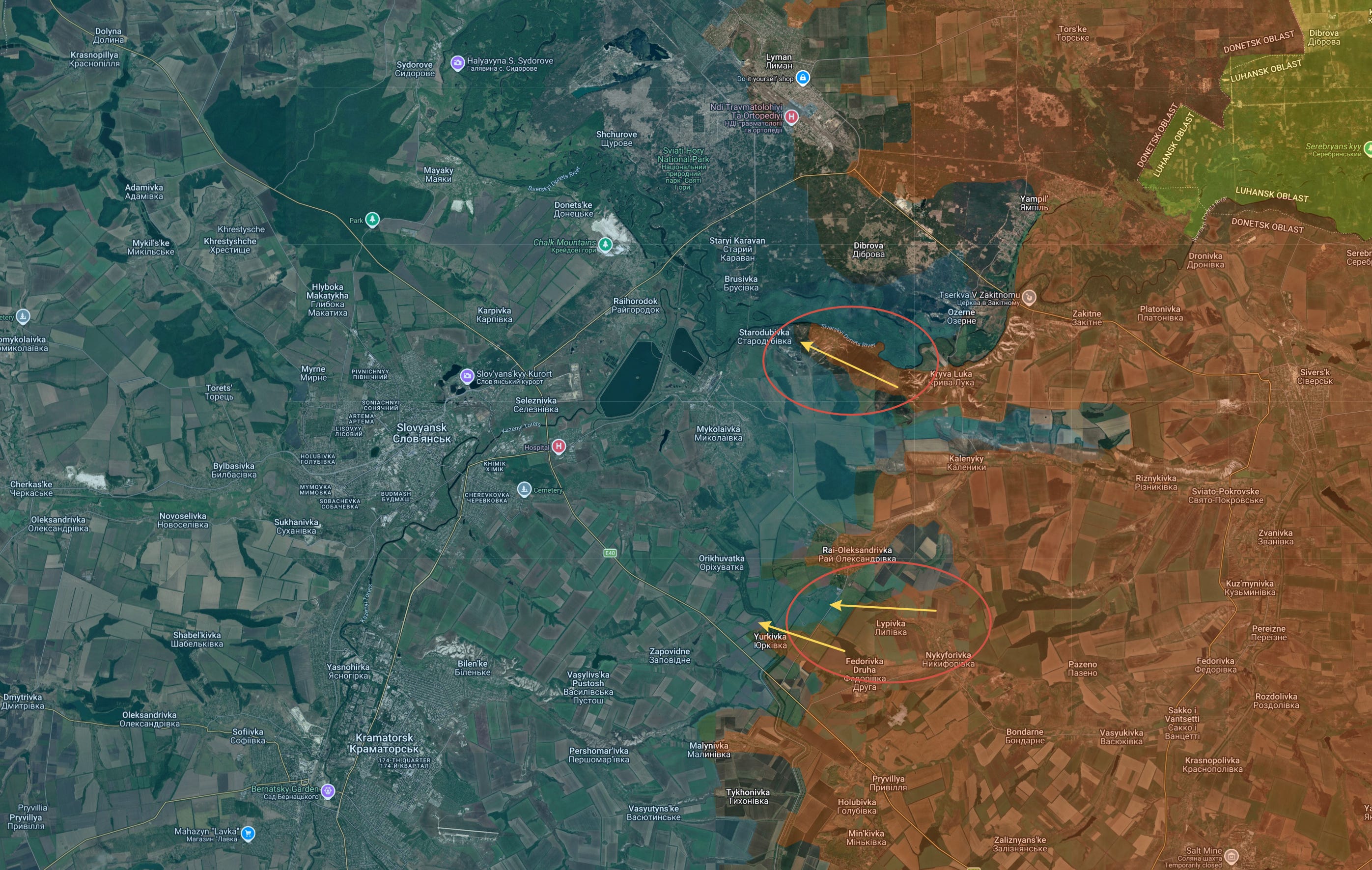
Situation on Siversk, Mykolaivka & Soledar fronts: During the last week, Russian Army has eliminated the Ukrainian presence in the salient (with the exception of eastern Rai-Oleksandrivka, where Russian shelling continues) and advanced northwest of Lypivka. In addition, Russian forces regained positions southwest of Zakitne and south of Kryva Luka, while operations continue to eliminate the Ukrainian presence in the salient north of Kalenyky-Riznykivka
The wider map shows the area in reference to Slavyansk just to the west:
A video was released detailing the capture of Piskunovka in particular by the Russian 7th Separate Guards Motor Rifle Brigade:
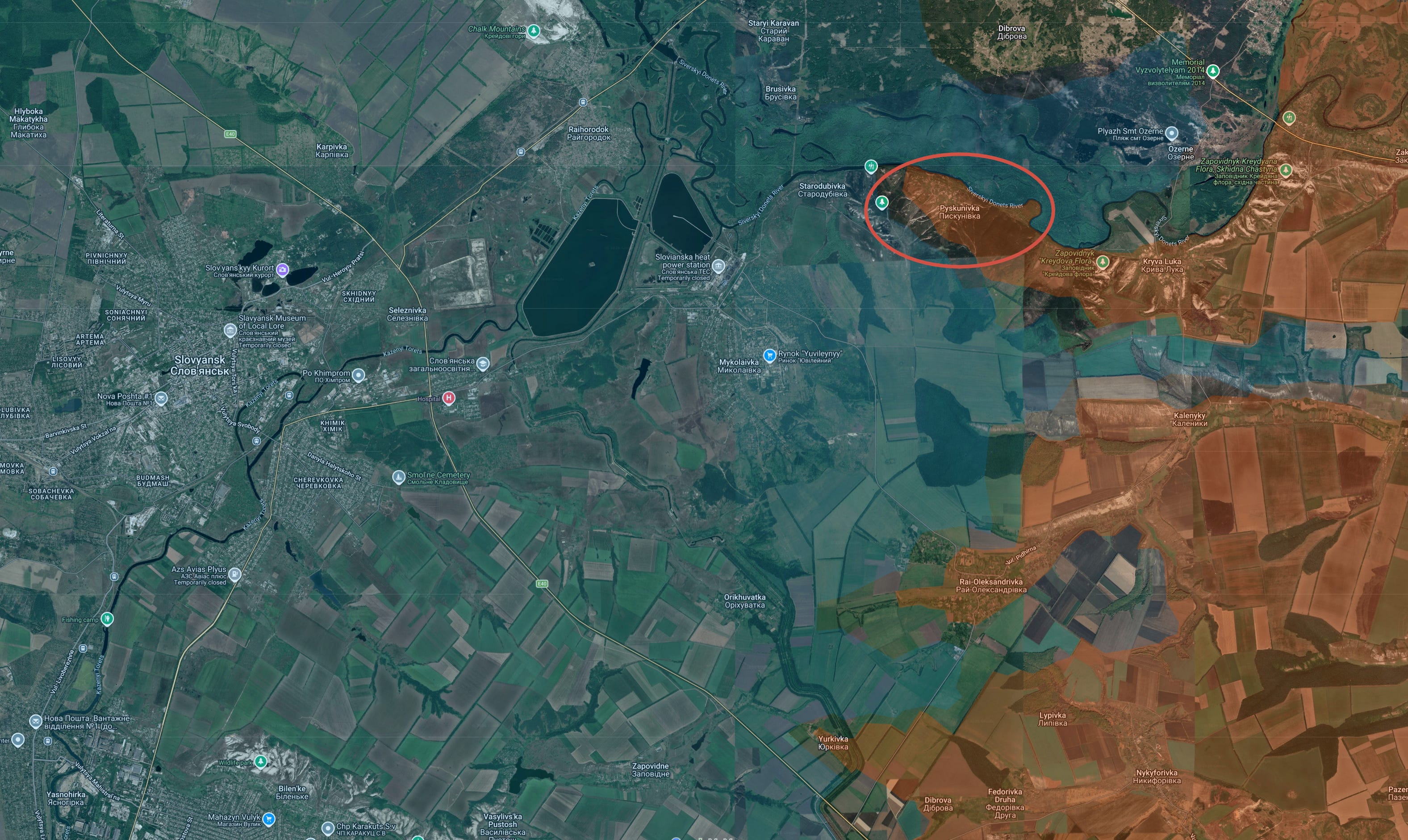
The 7th Separate Guards Motor Rifle Brigade of the 3rd Guards Combined Arms Army captured the village of Piskunovka in the direction of Slavyansk.
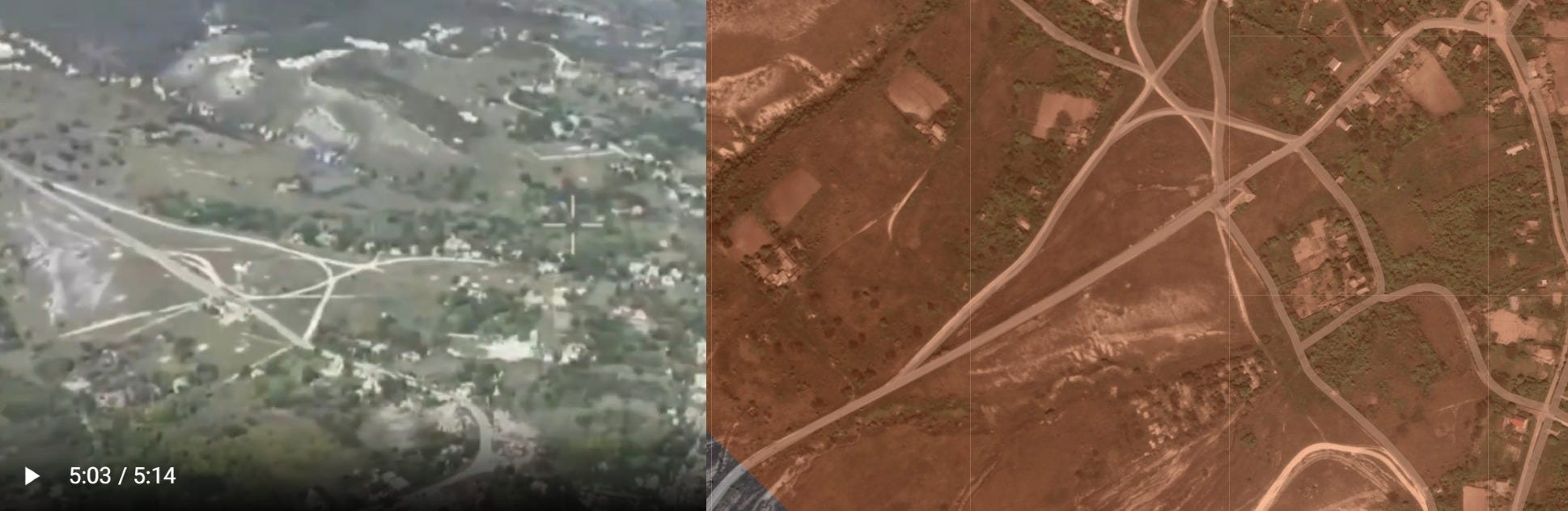
In the video, we can see this area at geolocation 48.887531624208215, 37.83093388733144 corresponds on the map:
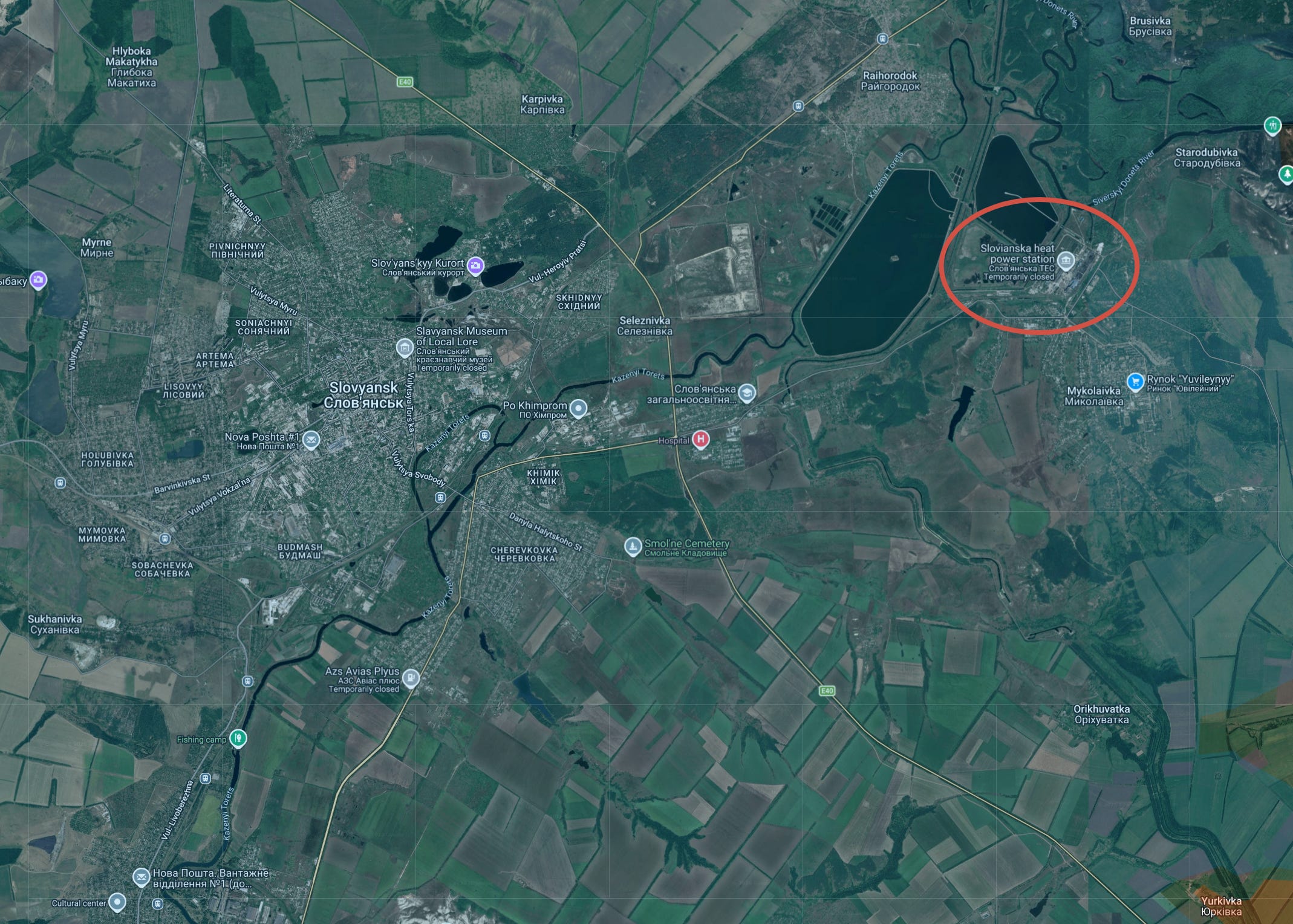
And what’s interesting is that in the video the Slavyansk power station is visible in the distance:
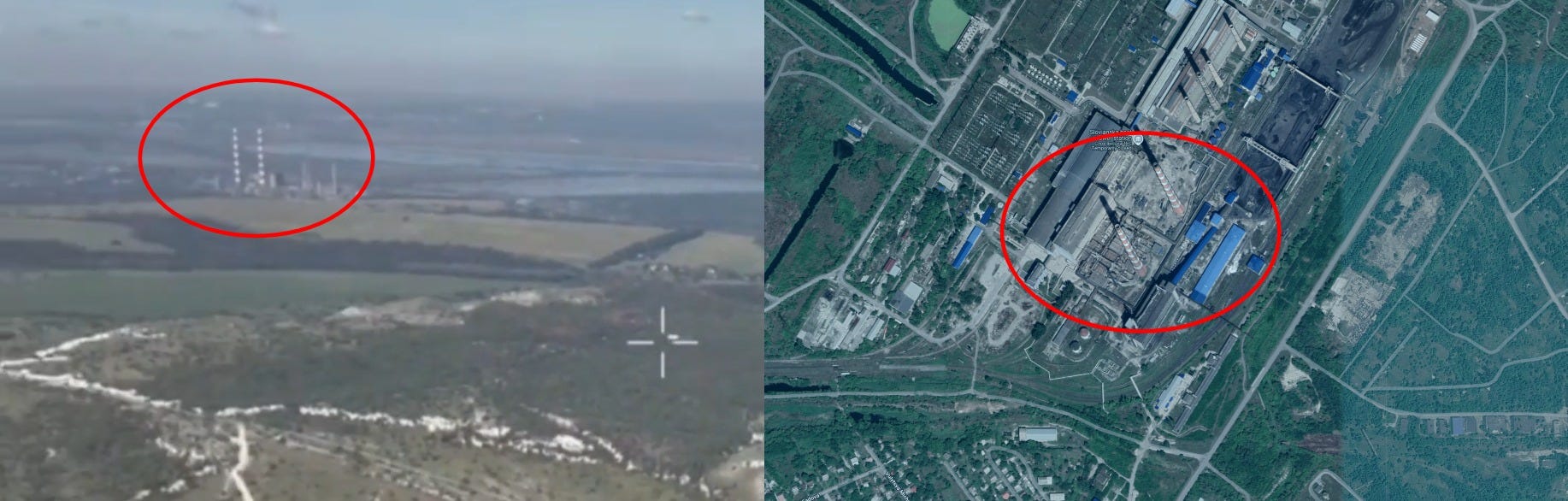
It sits precisely here in relation to Slavyansk city proper:
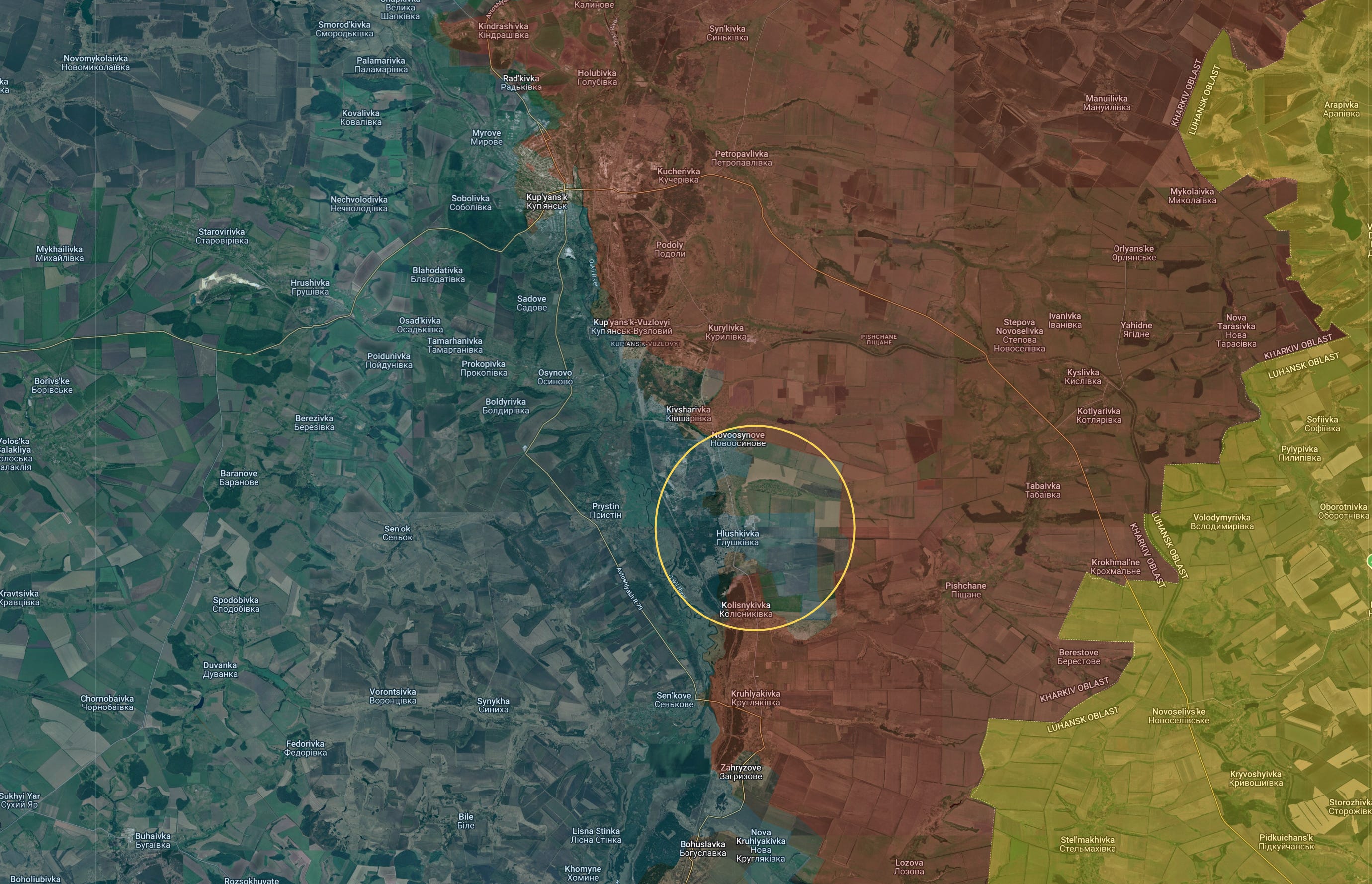
In the Kupyansk zone Russian troops have continued taking the entire area east of the Oskil river as well as the western bank of Kupyansk itself.
We can see that only the small section circled in yellow is now all that remains on the eastern side of the Oskil in that zone:
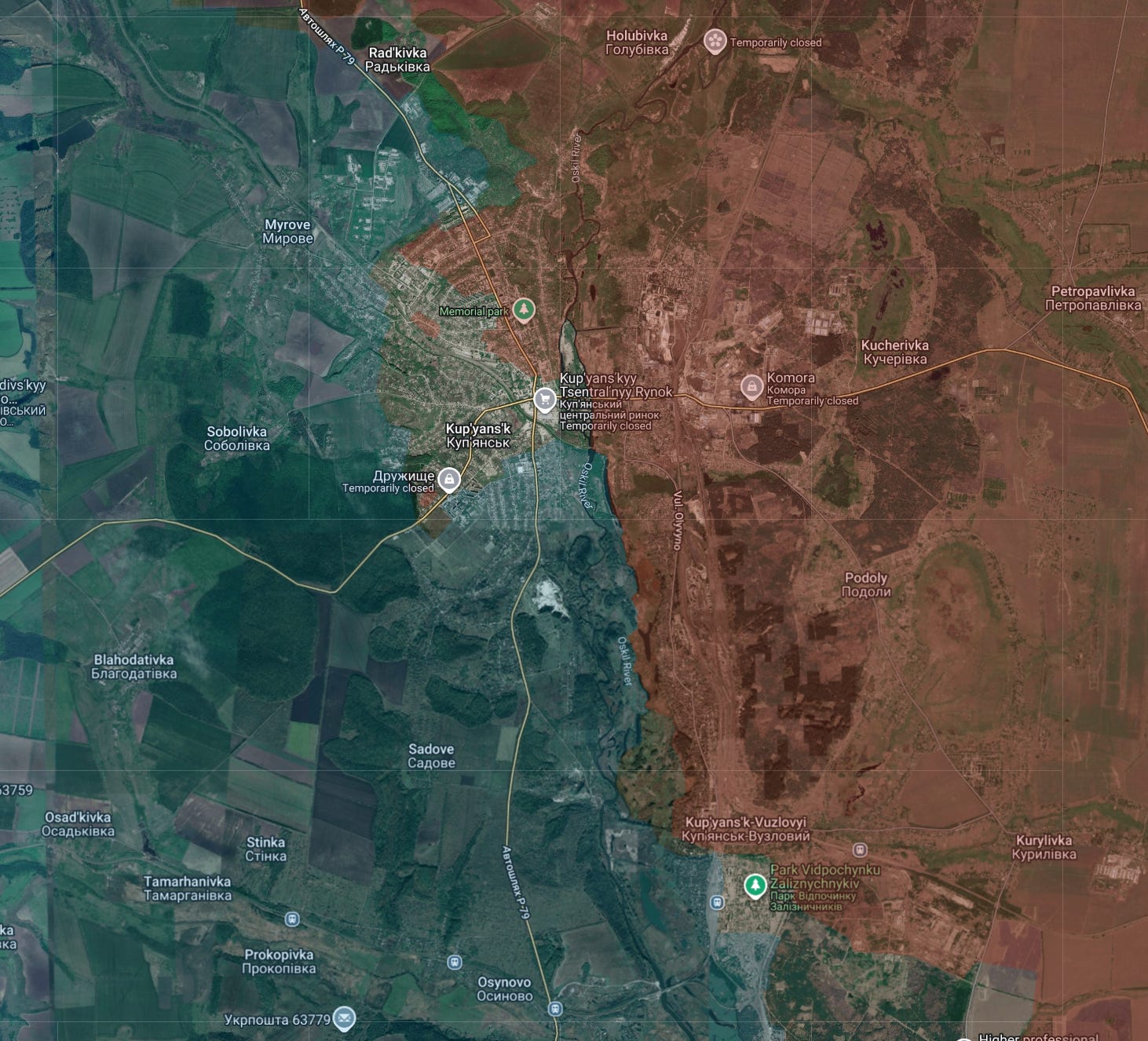
Kharkiv region. The soldiers of the 68th division continue their infiltration in Kupiansk and north of the city. They are also advancing in the area of Kupiansk-Uzlovoye.
Kupyansk itself has been re-infiltrated on the western bank, with Russian forces slowly recapturing it:
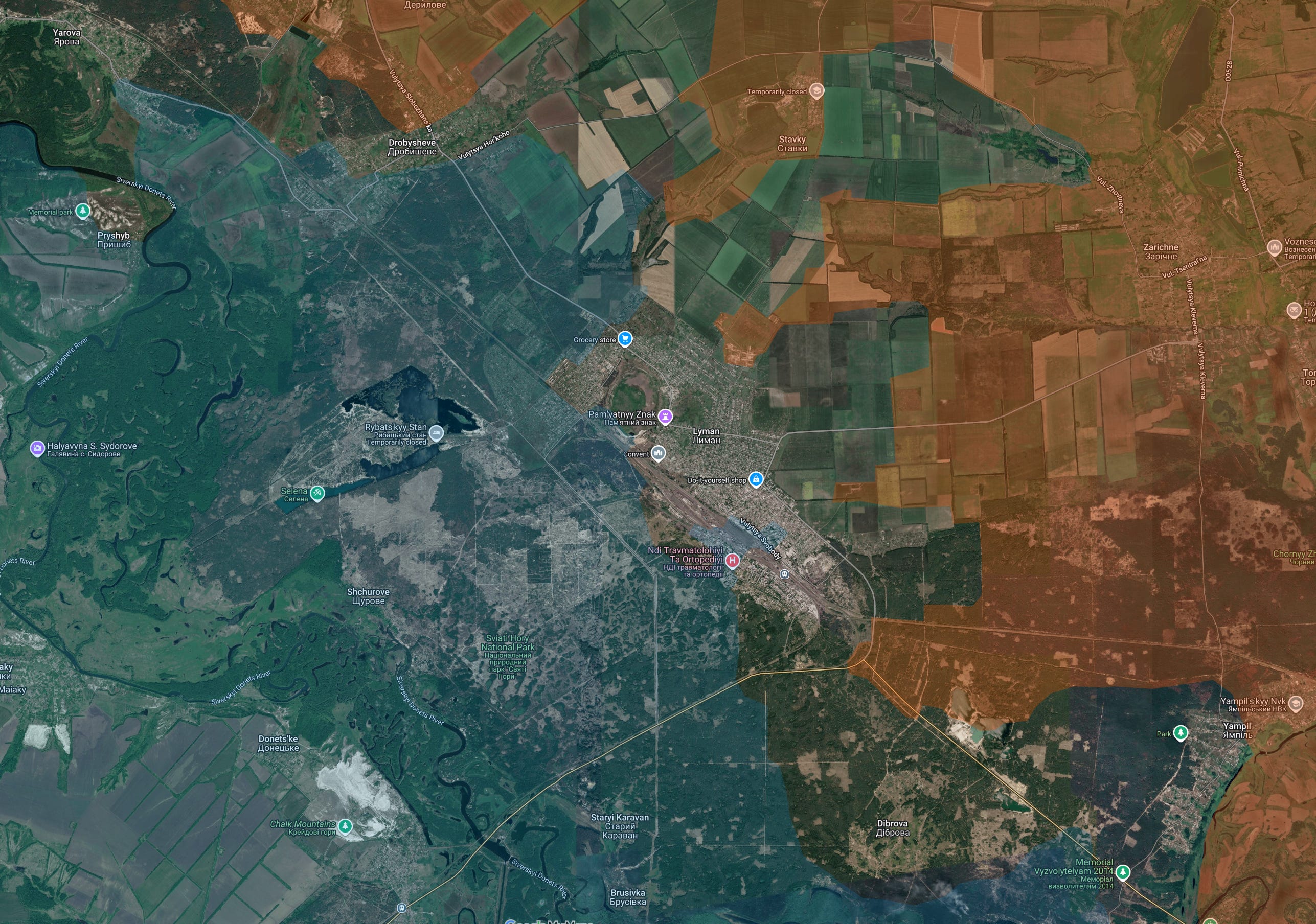
Lastly, south of there Russian forces have continued infiltrating most of Lyman with fighting reported all around the city but no direct control for either side:
The general broad takeaway is that the front is approaching Slavyansk-Kramatorsk, with Russian forces now said to be 8.5km from Slavyansk (Piskunovka to outer Slavyansk city limits):
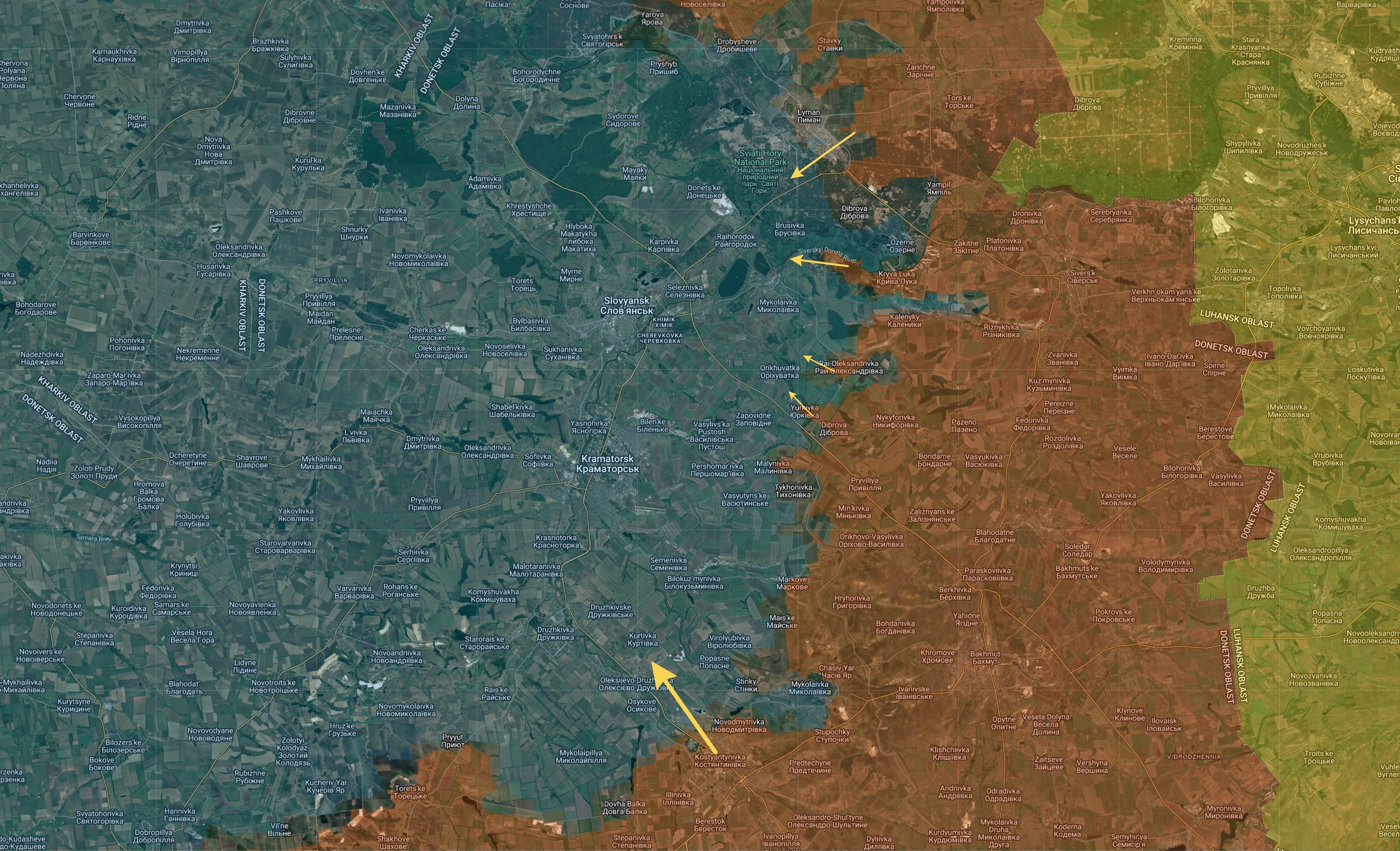
The final capture of Konstantinovka will bring the Russian Army up toward Druzkhovka and southern Kramatorsk in the same way the northern pincer is angling around Slavyansk.
As a special mention, Russia has continued pouring resources into the northern border where Russian troops have made their way alarmingly close to Sumy:
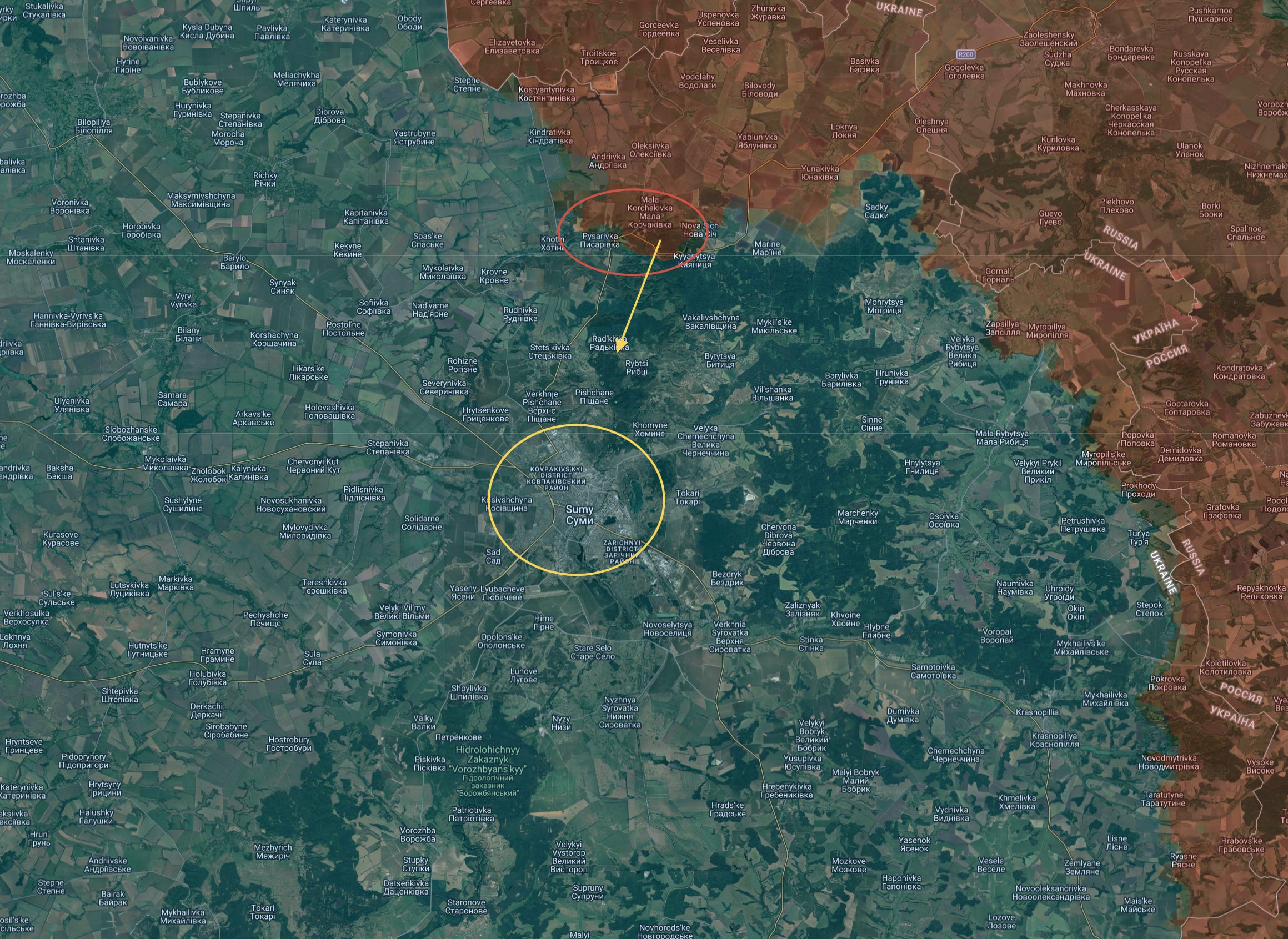
Recall the rumors that Russian DRGs are already operating in those forests juts north of Sumy even well below the actual area of control. They are likely shaping the ground for further advancement while Russian strikes have been disabling Ukraine’s fuel infrastructure and logistics on the main routes out of Sumy.
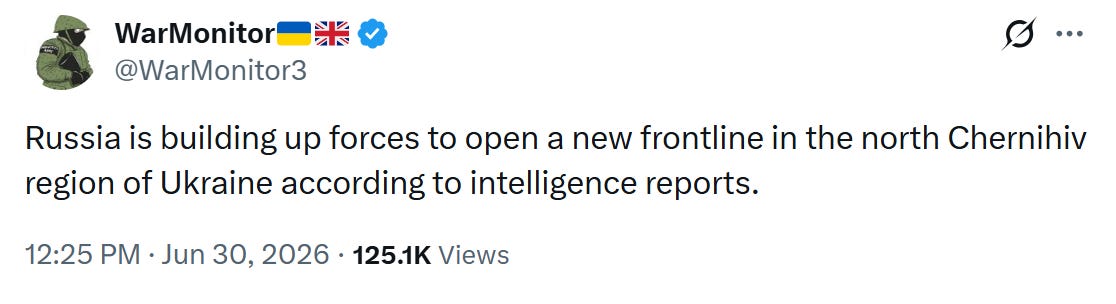
Now in his latest interview C-in-C Oleksandr Syrsky has declared that Russia is preparing a major offensive on neighboring Chernigov region with the aim of potentially having another go at Kiev:
We’ve heard such rumors for years, but never directly from Syrsky himself.
One interesting thing he notes is that the Russian General Staff appears to have made several different contingencies, depending on how the situation unfolds, particularly vis-a-vis Belarus and whether Lukashenko allows Russia the use of its territory for launching an assault. One of the things this appears to imply is that Russia is playing it by ear and will consider utilizing Belarus depending on how things play out.
And which things could those be, that could trigger such a contingency? The most obvious answer: Belarus being forced into the war after being attacked by Ukraine. In short, it’s possible that the Russian General Staff is providing for a plan that should Belarus forcibly be brought into the war, then Russian troops will be able to use its territory without creating any ‘thorny’ political issues.
Recently, we’ve obviously seen Zelensky threaten strikes on Belarus directly, if they did not turn off the signal repeaters Zelensky claims are aiding Russian drones. In the same interview, Syrsky admitted that one of the transmitters recently “turned back on” during Russian strikes:
And the following day:
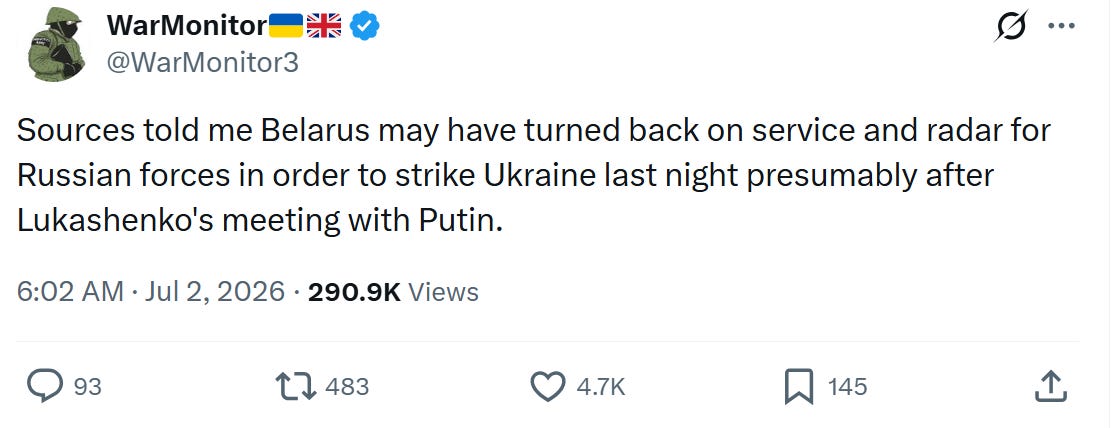
Seems Lukashenko pulled a troll job in switching off the relays when they aren’t being used merely to lull Ukraine into a false sense of security and turned them back on when needed; or perhaps the whole relay thing is just another psyop by Zelensky in his bid to lasso Belarus into the war.
But the point stands that if what Syrsky said is accurate, Russia may be waiting for the moment Ukraine forces Belarus into the conflict to then use Belarus for staging troops toward a Kiev operation. And if Zelensky backs down from his Belarus gambit, then those extra Russian troops will likely take part on the newly-rumored Chernigov front.
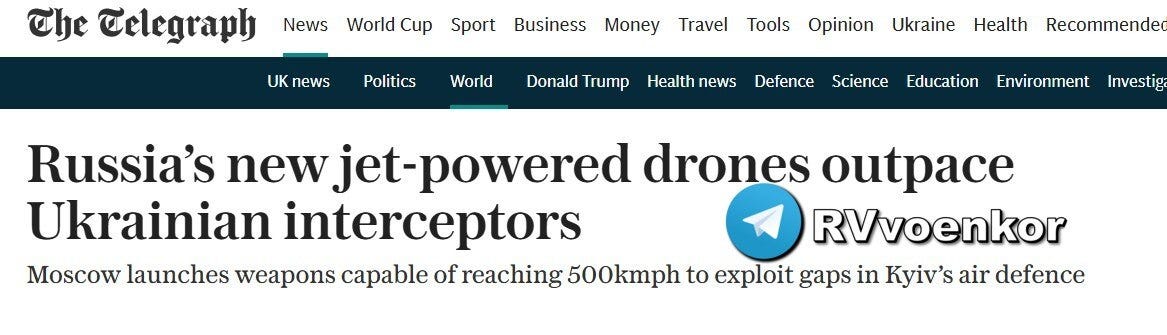
One of the reasons for Zelensky’s paranoia of late is that Russian drones have become increasingly sophisticated and effective. Russia’s growing “mesh” network has effectively become a Starlink-lite, and all types of Russian drones now regularly employ both jet engines and autonomous AI capabilities.
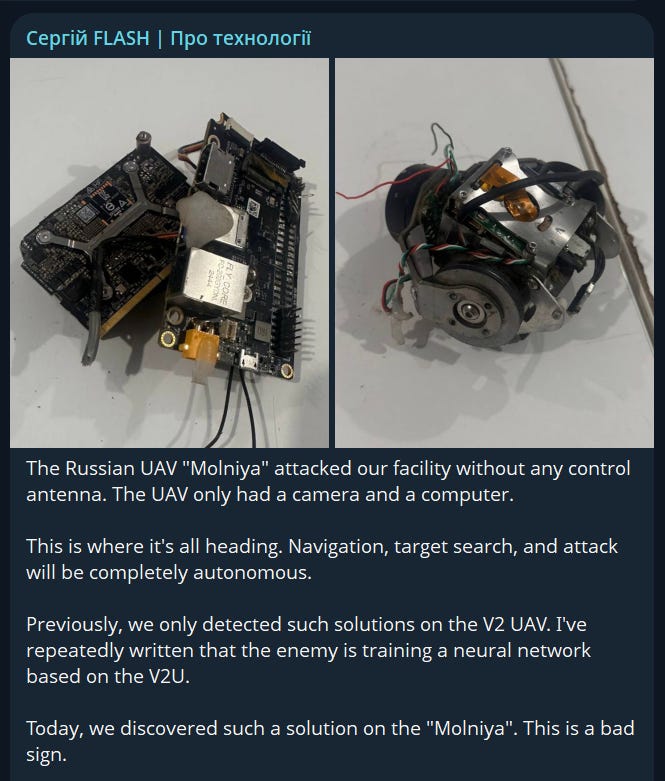
Here Ukraine’s top radio-electronics expert Serhiy “Flash” Beskrestnov shows great concern at the recently discovered autonomous version of the Russian Molniya (“Lightning”) drone:
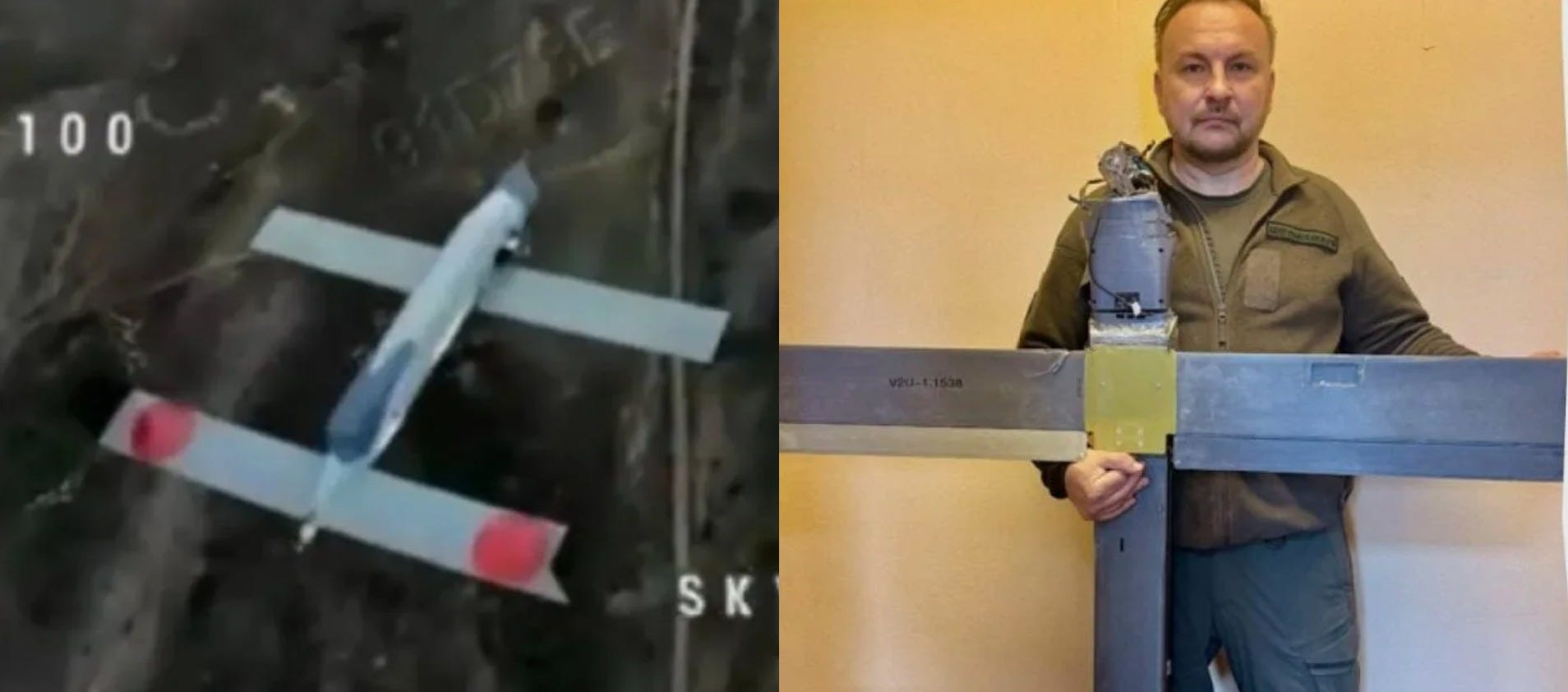
Recall the V2U drone he mentions, which we covered here before. It flew with strange “marks” on its wings which were theorized to be used for AI tracking and swarm communication. Here’s “Flash” himself with one of these models:
Now he says the Molniya has become the second Russian drone after the V2U to be operating in fully autonomous mode—that is, it has no controlling antenna or unit at all. The reason this is so dangerous is because controlling antennas emit powerful radio waves (RF) back to the controlling unit—i.e. the soldier piloting the drone. These waves can be picked up by consumer spectrum analyzer devices, which allows the tracking or at least detection of these drones long before they get to target. But the lack of any RF emission means the drone is extremely stealthy and can only be picked up by radars, which is unlikely given its small tactical size and likely extremely low altitude of traversal.
As a last note, Russia has continued to repair and reinforce the various bridges to Crimea that Ukraine has hit with its drones.
Here’s the bridge on the Arabat Spit near Genichesk crossing at 46.14801262936198, 34.80767191953852:
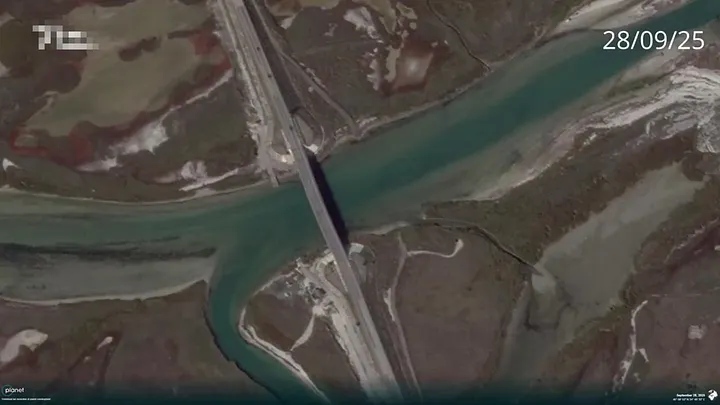

And here’s the Chongar bridge at 45.98760983618624, 34.55288684975514:
At the same time, the Russian campaign of destroying Ukrainian fuel infrastructure has ramped up, with reports claiming an additional 20 stations destroyed just along the Kharkov-Poltava highway in the past couple days:
The Russians have from 29 June to 1 July destroyed 20 gas stations on the Kharkov-Poltava highway.
For every one FPV drone the Ukrainians have, the Russians have 2. The firepower disparity is very much worse for UKR in every other category.
Rybar likewise published a map of June attacks. As can be seen the last few days of the month have seen a dozen or more stations taken out per day:
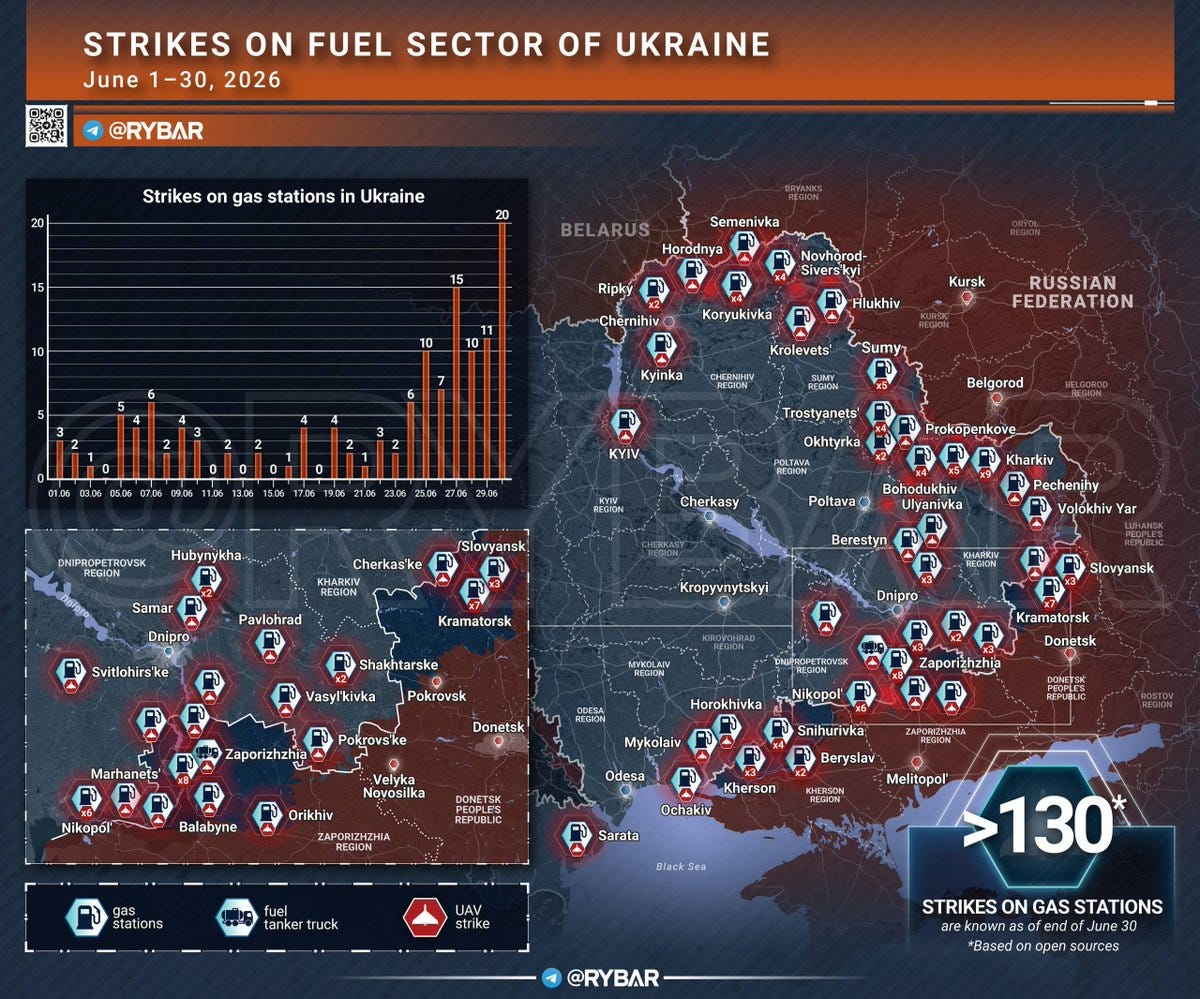
That’s ~130 in a month so far, and the strikes are only accelerating.
Russia has also been using Geran drones to take out gas storage sites:
Again we must be reminded that Putin recently shared that Zelensky secretly offered to end mutual long-range strikes. Russia declined—and the reason why is obvious.
Your support is invaluable. If you enjoyed the read, I would greatly appreciate if you subscribed to a monthly/yearly pledge to support my work, so that I may continue providing you with detailed, incisive reports like this one.
Alternatively, you can tip here: buymeacoffee.com/Simplicius
The unsettling message for the wider west (forget bonkers Ukraine) is that backing deeper strikes into Russia is not bringing Russia to the table, is not bringing Russia down internally, is not imploding its economy. It is ensuring that Western Europe will be left with far less of anything valuable in Ukraine at the end of it- which will be when Russia has control of Kiev and decision making processes, to establish an electoral victory. Sooner than you think since Ukraine cannot survive another winter- the west cannot afford for this to go on into another winter and then absorb the tide of refugees. All europe is achieving right now, is running the very real risk of its own fringe being turned into bombed out craters like Ukraine with the possibility of even deeper penetration by Russian attacks. To what end? To this- whole new governmental regimes across europe replacing the warmongers, to finally settle what could have been settled to far better return for europe years ago.
And no, the US is not going to ride to the rescue, and this applies whatever the November outcome. It wants an expensive embarrassment in Ukraine to top its expensive Iran embarrassment like a crater in its own head. Hence Trump keeps saying- we sell em weapons give then info back up, but that is all. (implication- if they lose, it will be down to them not least for refusing to co operate with our efforts to settle the war when they could have come out still standing).
That strike was, technically, 2 nights ago, on Wednesday - if counting European timing GMT/UTC, and not Pacific Time PT.
Russia needs peace negotiations with Ukraine to stop hostilities and turn Ukraine into it's ally. Divide it politically into a peace and war camps. Zelensky can't negotiate, it means end if him, including legal prosecution and life sentence. Putting pressure on command posts, that including Kiev hotels with mercenaries, and later on the whole government and Zelensky's lifes, would trigger or deepen that split.
That internal conflict will cause bloody civil war in Ukraine, it's partition into 2-3 pieces. The largest part will be associated with Russia, controlling access to the whole Black Sea, taking over Odessa ports to Romanian border and Transnistria.
The earlier plans to smuggle nationalistic rump state from divided Ukraine into European Union and into NATO are falling now apart. There was a proposal to create Polish-Ukrainian state union, with millions of Ukrainians flooding south-east Poland and granting them autonomy. But within the last month there is a very strong political opposition from Poland to such developments, and that also includes radical change in public opinion. That opposition is associated with the USA interests in Europe.
So time has came when Europe's Epsteined elites need Zelensky to wreak havoc as much as possible, escalate into wider war, including Belarus and to involve deeper all Europe into conflict with Russia. To divert her from Iran, Israel, Middle East and the other parts of world.