

Russian Oligarch's True Warning Hidden in Plain Sight

The Economist published two important pieces centered on Russian “oligarch” Andrey Melnichenko, who is labeled one of Russia’s most ‘enigmatic’ wealth titans despite at times occupying first place amongst Russia’s richest men as, what Economist calls, the world’s “fertilizer king” and Russia’s “biggest industrialist”. He’s presented as particularly unique due to his more “centrist” position as someone who’s both inhabited Putin’s inner circle, yet also spent years living the Westernized liberal and Europhile lifestyle typical to Russian billionaires.
The first piece is a kind of introduction to him, while the second piece is an oped written by him and given tribune on the Economist as a kind of urgent message to the world about Russia.
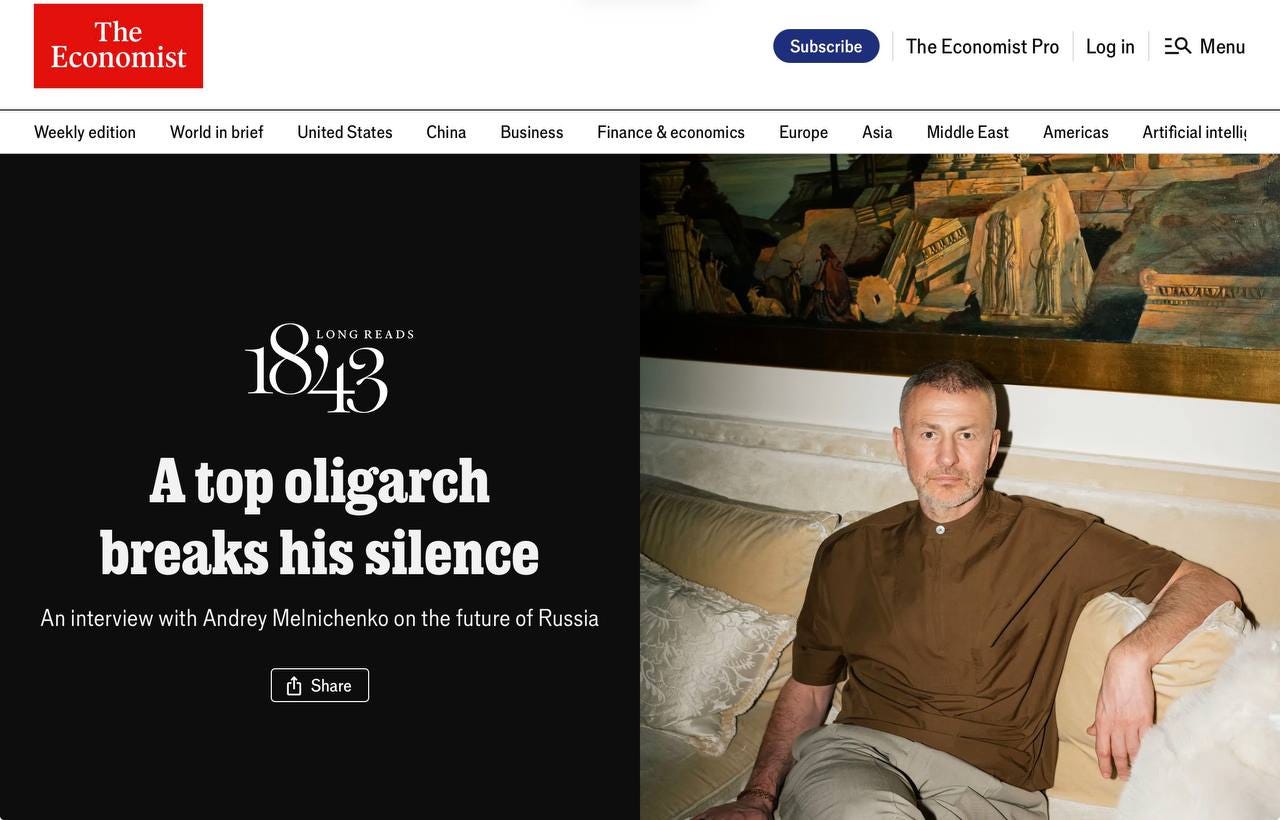
The piece is long and filled with some interesting revelations. In its quest to skew the narrative toward the usual “Kremlinology” talking points of oligarchs serving a powerful undemocratic Russian autocrat, the Economist instead inadvertently gives light to contradictory realities. It exposes the fact, for instance, that contrary to the West’s beliefs, oligarchs in Russia had already been without real political power for some time, though the writers would never dare utter the reason why:
When Putin invaded Ukraine, the world waited for Russia’s rich and powerful to speak against the war. But they stayed quiet. The West imposed sanctions on them, partly to make them apply pressure on Putin. But this betrayed a lack of understanding of how power worked in Russia—the business elite had long given up trying to influence politics.
The journal admits that Western sanctions actually did the opposite of their intent, and pushed Russian elite back into the state’s bosom, with Melnichenko—who chose to live in Switzerland for a long portion of his life—himself admitting that for the first time he felt Russia was his only home:
Putin himself was worried the oligarchs would betray him. Instead sanctions pushed them back into his embrace. Yet when they returned, they repatriated their interests and ambitions along with their money. Melnichenko’s opening gambit when our conversations began three months ago was: “For the first time I feel I have no other country but Russia.” Given the reticence of his peers, it is astonishing that Russia’s most enigmatic oligarch, while living in Moscow, is willing to put his head above the parapet and lay his views on the record.
It goes on to even admit that, following the onset of the SMO, the Russian state did in fact begin confiscating oligarchs’ assets and returning them to “loyalists”:
At around that time he and other businessmen realised that the war would not end soon. With no reprieve from sanctions in sight, they started to repatriate themselves back to Russia, where they faced a different kind of threat to their assets.
Property rights in Russia had always been conditional. But the war unleashed a rapacity that hadn’t been seen for decades. Since 2023, assets worth $60bn have been nationalised or handed over to loyalists. It was the biggest redistribution of property since the mass privatisations of the 1990s.
In August 2023 prosecutors sought to confiscate Sibeco, a Siberian power plant, from Melnichenko, arguing that his purchase of it had involved fraudulent collusion with the previous owner. Two weeks later, the prosecutor-general’s office backed down in return for Melnichenko making a donation to a “charitable organisation”. According to people familiar with the settlement, the sum was 32bn roubles ($335m)—the same amount that Melnichenko had originally paid for Sibeco. The charitable organisation was Sirius, a school for gifted children favoured by Putin.
This is important to understand because it highlights this Economist series’ entire underlying thread, which is that the SMO has been slowly revolutionizing Russian society, turning the oligarchs back from liberalized sixth columnists to nation-serving adherents in the manner of China.
Melnichenko was amongst the first and most astute to recognize what must be done. He decided to get back in good favor with his motherland, which he had begun to use merely as a source of extraction and profits while he enjoyed life abroad. He returned and began to ingratiate himself with Russian elites, re-learning the system and re-absorbing the true national ‘pulse on the ground’:
Melnichenko now knew that he needed to establish property rights in Russia. The only way to do this was to work his way into the system, understand the competing interests and help shape its objectives. “If you want a seat at the table, you have to do something.”
As always he began by observation. “In 2023 I started to spend more time in Russia and was getting to know it in a much deeper way.” He talked to anyone who had a stake and a viewpoint: “politicians, journalists, thinkers, liberals, nationalists, communists”. He could be found having breakfast with Dmitry Muratov, the Nobel prizewinner and founding editor of Novaya Gazeta, a liberal newspaper, who was ostracised by the government and branded a “foreign agent”. In the evening he might have tea with Alexander Dugin, a nationalist philosopher who glorifies the war.
But here’s where the entire Economist series hinges. In his quest to re-integrate into Russian society, Melnichenko discovered that Russian elites are confounded and lack a unified vision of a workable future, for the time being. He then notes that Russia is seen as standing at a crossroads between four different potentialities, all of which sound grim, and which the Economist uses as the chief centerpiece to hook the series’ narrative on.
But it is a deliberately misleading hook, because they disingenuously present it as Melnichenko’s visions of a collapsing Russia with no options. In reality, Melnichenko presented the four “doom” scenarios in order to really pose his fifth redemptive one.
And what is that? To find out, we must peer into the second piece, written by the man himself:
In the piece, he keeps a deliberately neutral language in regard to the Ukrainian conflict, never quite openly blaming Ukraine or Russia, despite rumors he had been outspoken against the Russian SMO in the past. Now he’s clearly treading a fine line, and hoping for resolution which benefits himself, as well as society.
Critically, the theme of his entire piece can be condensed into one word: Sovereignty.
He accuses the West of trying to undermine and sabotage Russian sovereignty, and carefully implies that the broader conflict between Russia and the West revolves around the West’s disintegrating security architectures viewing Russian sovereignty as a threat to them—which is precisely accurate and true.
From his piece:
Russia today possesses sovereignty: it has made and continues to make its decisions independently. This is not an evaluative judgment but a descriptive one. Russia has defined its vital interests, possesses the material base to defend them and bears the consequences of its own decisions.
The current Western discourse on post-war Russia, for all its variation in political packaging, aims at one thing: the destruction of that sovereignty or its radical limitation. The logic is understandable. If Russian sovereignty is perceived as a threat, its elimination seems to solve the problem.
He goes on to pose the four scenarios, though it must be said, he specifically notes these are scenarios being discussed in the West—a stark contradiction to the Economist’s attempted painting of these “harrowing” outcomes as those feared by Russian elites as represented by Melnichenko.
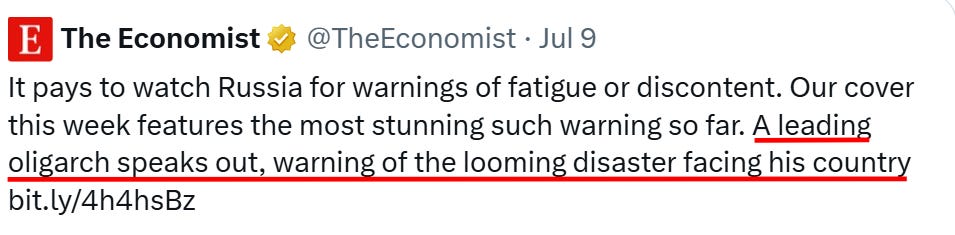
You see, he doesn’t warn of any “looming disaster” facing Russia, but rather paraphrases threats the West itself is scripting, which is an all-too-inconvenient fact for the Economist staff who rather spin it in a more sensational way. It serves their agenda to pretend it’s “Putin’s own oligarchs” who are sounding the alarm of Russia’s “coming collapse”.
The four scenarios Melnichenko gives are:
“A humiliated Russia lingering on the periphery of the West.”
Russia becomes a vassal of China, ending its relationship with the West.
Russia becomes fragmented and falls apart like the USSR.
Russia becomes a “fortress: closed, mobilized, in permanent siege”, and a state of “perpetual emergency.”
As stated, these are Western fantasies, and the ‘Overton window’ of Russia’s future that Western politicians and pundits alike would like us to believe is the only trajectory of Russia’s fate. Melnichenko tacitly disagrees, but cleverly makes sure not to make this too obvious as he’s writing for a Western audience for the purpose of reconciliation.
Melnichenko finally reaches the inescapable conclusion, which is that the very heart of the conflict revolves around the issue of Russian sovereignty, and by ignoring this, the Europeans doom the conflict toward existential escalation:
How Russia conducts its own political process and towards what ends it directs its sovereignty is a question that can be resolved only inside Russia itself, without deference to external preferences. Any attempt to manage this process from outside is not only doomed but counterproductive: it destroys the very condition—sovereignty—without which sustainable peace is impossible in principle. This must be accepted, not out of sympathy for Russia but from the understanding that no alternative to this recognition exists.
He goes on to lay out a rather brilliantly nested exegesis which is a message, and a hidden threat, to the Western order. Like a Matryoshka doll, he conceals this message beneath layers of “openness” that appear ostensibly as calls for understanding and cooperation with the West. In reality, what he’s laying out is his accurate portent for Russia’s future, one where businesses, oligarchs and citizens alike, all work toward a common sovereign revolution. This is sold as being beneficial to the West because, as he foresees things, it creates “predictable” stability—but the real threat is hidden in the message that the West is pushing Russia to become more unified and powerful than ever before.
I have grounds to believe this reckoning will come, and these grounds can only be understood by explaining why it has not come sooner.
Those who built the new Russia—entrepreneurs, scientists, artists, sportsmen, professionals who created its economy, its meaning, its reputation in the world—largely saw themselves as internationalists. This was neither weakness nor naivety. It was the obvious choice in a world where global integration seemed irreversible. Science operated by international standards, technology came from the best sources, rights and obligations were governed by Western law in Western courts, children studied at the world’s best universities, capital was placed where it was protected. This choice meant, consciously or not, the transfer of a significant part of sovereignty to external systems. Not because that was the desire. Because it seemed that the rules were neutral and access was open to all.
After spelling out how the new Russia was built by internationalists, he admits that globalization was a failure because it was nothing more than a ruse to take away Russia’s sovereignty:
For many years Russia’s authorities warned that this was a mistake. The advocates of global integration viewed this as a remnant of Soviet thinking. Time has proved them wrong, not because globalisation did not exist but because it was never neutral.
Sanctions showed this plainly. They were written by some, in the interests of some, and can be revised for others by political decision. My own experience of Western sanctions matters here not as a personal grievance, but as evidence that the infrastructure of globalisation is politically conditional. Assets can be frozen; rights once considered inviolable dissolve the moment a political decision is taken.
The systemic effect of sanctions proved broader than their original intent. Disconnection from global systems—financial, technological, legal, educational—confronted Russia’s creative class with a choice it had not anticipated: either full emigration with the severing of all ties, or a return to the question it had been avoiding for three decades: how to build its own world inside Russia, by its own rules, to its own standards.
He concludes that this process of rebuilding Russia as a self-contained ecosystem, “by its own rules, to its own standards” will not come fast or easy, but it is now fatefully ensured:
This process is neither fast nor easy. But it is inevitable, since the global world in its former sense no longer exists. Those who know how to create find themselves choosing not between Russia and a global space, but between Russia and a fragmented world in which each bloc builds its own rules. Under these conditions, the logic of creation points inward: to build something that will be attractive—to those who left long ago with the dissolved Soviet Union, to those who left recently, and to the Russian-speaking world at large.
Layered even deeper in his admonishment is the prediction that expats and Russian businesses alike—particularly those which may have sold out in the beginning, it is implied—will again eventually find their home in Russia:
Large Russian businesses that invest in a sovereign Russia will, in time, become an integral part of it. The same will hold for other important institutions. As a consequence, Russia itself will become different. If we strive for a sovereignty that creates unity between citizens and institutions, I hope that in time we will correct all the internal imbalances for which we too bear responsibility—through the fact that we were once glad to absent ourselves.
In closing, he argues that such a sovereign, internally coherent, and unified Russia will not please the West, but it will be a far safer option than a Russia destabilized and fractured to the point of dangerous unpredictability:
The attraction of predictability
A sovereign Russia will not make every country comfortable. But it will be more advantageous in the long run than the alternatives. The choice for external players is not between a friendly Russia and a hostile one. It is between a Russia whose behaviour is predictable and one whose trajectory is unknown. In the world taking shape now, predictability is more important than sympathy.
The internal discussion about what Russia should be is inevitable. But that conversation belongs after the war and inside the country.
Once more, buried within the goodwill courtesies and ingratiating overtures toward the West, Melnichenko infact subtly retraces Putin’s own longstanding call for a renewal of the Westphalian system which the West itself had long abandoned:
The choice before the world is not between love for Russia and hatred of it, between punishment and forgiveness, between moral clarity and political cynicism. It is between two kinds of future: one in which major powers again learn to respect each other’s sovereignty, and one in which each attempts to reduce the others to objects of management. The second path has already brought us here.
The most important thing is that we step back from the abyss. Only then can we ask how we reached it and how to arrange the world differently. That work belongs to the next generation. Our role is to ensure they have something to work with.
In short, Melnichenko’s piece is in effect a Trojan horse of sorts: With a subtle appeal to the West’s sympathies—and its ego—meant to lull and disarm Western readers to his true message, he deftly delivers the thematic heart of Putin’s own longstanding arguments, famed from the days of the seminal 2007 Munich speech.
The Economist appeared to sense this hidden subversion in Melnichenko’s language and was forced to quickly publish a third additional ‘addendum’ piece simply to reframe his message to the tune of the correct narrative.
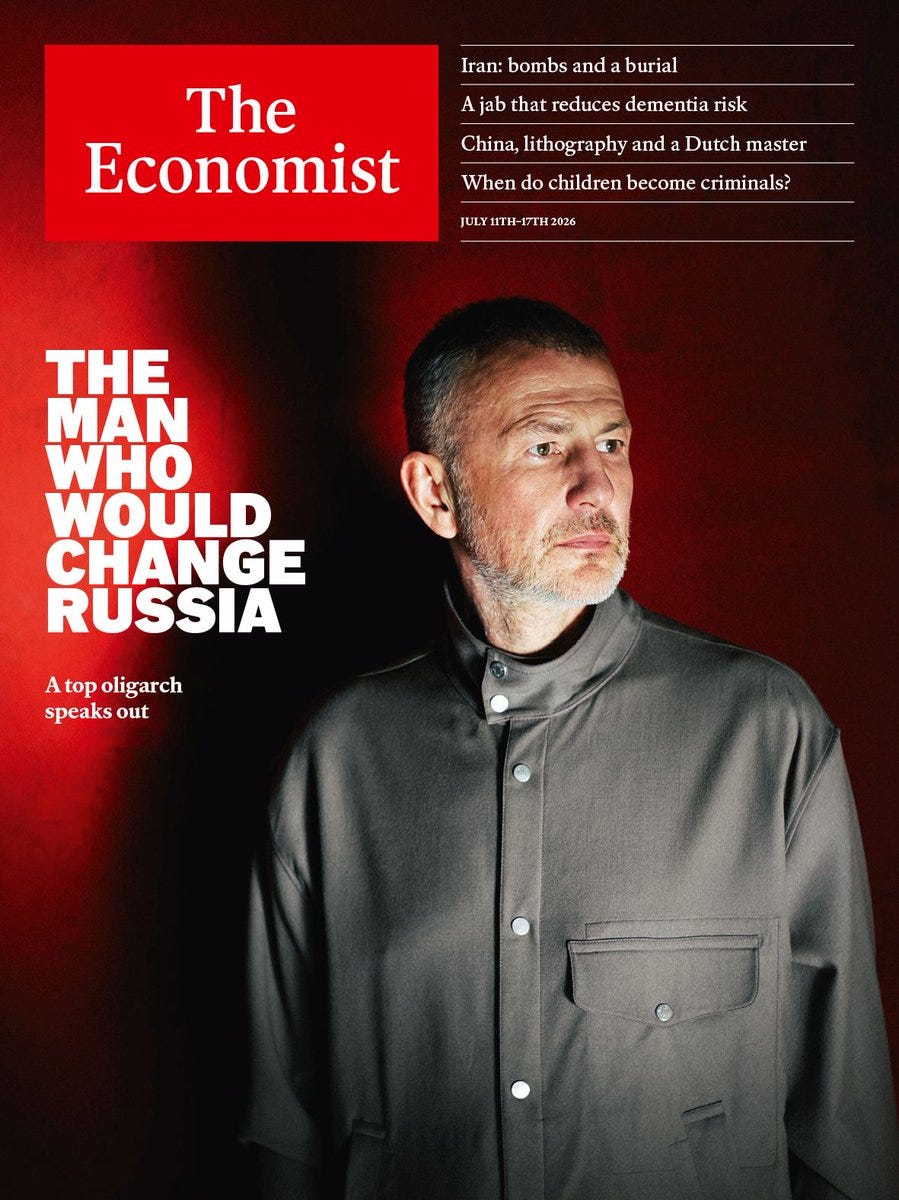
This unprecedented third piece of the day on the same topic is brief and to the point—only a few paragraphs in length. Its purpose is obvious: to control the narrative by highlighting only the most superficial platitudes and inferred “warnings” of Russia’s collapse, while burying the deeper hidden message which unequivocally declares that the West is pushing Russia into a historic reawakening of its national soul, wherein oligarch, corporate powers, and citizens alike unite under one common purpose of betterment for the nation.
The new piece above goes into full damage control mode, disingenuously miscasting Melnichenko’s return to Russia as a bid to save the country from internal “rot”:
…he has lived by Mr Putin’s rules—make money, but keep your nose out of politics. He is talking now because he and his fellow tycoons can no longer afford to ignore the rot of a country they watched descend into tyranny.
In reality, Melnichenko himself clearly states he came back not because of Russia’s corruption, but due to the West’s own unhinged and unprincipled immorality—sanctioning and seizing his assets, etc. Economist shills even openly wrote a disclaimer in order to distance themselves from Melnichenko’s thoughts, just in case their readers happened to intuit the true message beyond the Economist’s superficially phony “collapse” narrative:
Mr Melnichenko issued his warning in over 60 hours of interviews with The Economist (see 1843) and more guardedly in an essay that we are publishing online. This is the first time an oligarch inside Russia has spoken out at such length. We are giving him space not because we agree with all his views or he is a champion of democracy and human rights. Instead he is a pragmatist who wants his businesses to thrive. That is why his call could resonate in a country where wars gone wrong, including the defeat to Japan in 1905, have led to campaigns by industrialists for political change.
In short, the damage control piece desperately tries to change the message, but to those who know how to read carefully, Melnichenko’s words are clear: the war is the West’s fault, and Russia is being restructured as a self-sufficient society of supreme sovereignty where even the previously-alienated liberal class of exiles and pariahs has returned with newfound patriotism in its veins. A nation where oligarchs and big businesses are increasingly working for the benefit of the state and its people, rather than the crooked Western system which deceived and betrayed them.
The Economist tepidly tries to spin this message into an epigram about “reform”, and how the current moment is supposed to reflect the period following Russia’s loss to Japan in 1907, culminating in the Tsar’s overthrow during the later revolution. This is wishful thinking and naked sophistry on the part of the Economist staff, who are too terrified to voice Melnichenko’s true thesis.
It is a sure sign of the times that even Russia’s so-called “oligarchs” are now warning the West that it has freed the Russian genie from the bottle, and that there will be no turning back. But, as per usual, the message has fallen on deaf ears, because the Western system has decayed to such a degree that it can at this point function only on lies, propaganda, and deliberate misinterpretation.
In the West’s fragile court, the acquittal of a single truth is now too dangerous a risk.
Your support is invaluable. If you enjoyed the read, I would greatly appreciate if you subscribed to a monthly/yearly pledge to support my work, so that I may continue providing you with detailed, incisive reports like this one.
Alternatively, you can tip here: buymeacoffee.com/Simplicius
"We are giving him space not because we agree with all his views or he is a champion of democracy and human rights"
They just can't stop wanking themselves into unconsciousness over their devotion to "democracy" and "human rights" whilst advocating for globalization that no non-"elites" want, free trade that bankrupts nations, and regime change that installs tyrants.
Great piece, Simplicius. Thank you!