

War Now Indefinitely Sustainable, as New Reports Prove Russian Armor Production Has Finally Reached Equilibrium

Last week we learned that the US’ 155mm artillery munitions production had suffered a major setback, falling from the peak 50,000 per month milestone, back down to a measly 40,000.
Now we turn to new revelations surrounding Russia’s own production of key systems, which have been tracked and updated by various Western agencies and OSINT experts.
The most significant of which has been an update on Russian tank production, specifically the T-90M. This is the most important Russian production line for the simple fact that it remains the only purely new tank being built from scratch in Russia, rather than tanks assembled from old stockpile hulls. This means that to some extent, the future of Russian armor depends on the T-90M line because if the war were to continue for years to come, it is obviously conceivable that old hulls will at some point run out, and the T-90M is the only model that can continue to be produced indefinitely.
First, on the team that did the research: it was done by Conflict Intelligence Team (CIT), which is a kind of open-source think tank formed by Russian dissident Ruslan Leviev back in the early part of the Donbass conflict and Syrian war of the 2014-2015 era. He is wanted by Russian authorities, and as such his team’s findings are obviously done through a pro-Western and pro-Ukrainian slant—which is what makes them all-the-more interesting, given the conclusions made.
Their main paper is found here.
I’ll post the full bullet points from the ‘key findings’ section, and comment on each in turn:
By the time serial production of the T-90M tank began in 2020, the Russian state-owned manufacturer Uralvagonzavod had produced between 120 and 150 original T-90 tanks for the Russian army (ed: this means total production), along with roughly 280 T-90A models.
In the post-Soviet period, Uralvagonzavod managed to preserve its production capacities, including its ability to manufacture armored hulls. At the peak of demand in the 2010s, the plant could produce up to 140 tanks annually, while also manufacturing tank assembly kits.
By the outset of the full-scale invasion of Ukraine, Uralvagonzavod had launched serial production and modernization of the T-90M Proryv [Breakthrough] tank, delivering between 66 and 85 of these tanks to active units. An additional ten were sent to the Kazan Higher Tank Command School. As of late 2021, the company aimed to reach an annual output of around 60 tanks.
Thus, by February 2022, the Russian army possessed between 65 and 85 T-90M tanks, along with 370 to 380 older T-90 variants.
Here we see that Russia was producing a reported ~60 or so T-90Ms per year by the start of the SMO. Remember, this refers specifically to the most advanced T-90M Proryv line, as opposed to regular T-90 or T-90A mentioned earlier. They state that at the start of the SMO, Russia possessed a total of 65-85 T-90Ms and 370-380 other older T-90 varieties.
Following the start of mobilization, all stored T-90A tanks were withdrawn from reserves and assigned to several units within the Russian Armed Forces. The original T-90s remained in reserve but were subsequently sent back to Uralvagonzavod for modernization.
According to our estimates, Uralvagonzavod produced 60-70 T-90M tanks in 2022. In 2023, amid efforts to mobilize the defense industry, output may have increased to 140-180 tanks, and by 2024, it may have surpassed 200 units annually, possibly approaching a production rate of 250-300 tanks per year.
Here we see that while in 2022 Russia was producing 60-70 T-90Ms, by 2023 it had increased to 140-180, and by 2024 it may have reached 200+ per year, and possibly even as high as 300.
The availability of new armored hulls does not appear to be a limiting factor and has not impeded production. All T-90M tanks currently being produced are newly built.
This is the most significant of the statements: they confirm that all T-90Ms currently being built are completely new, and not mere refurbs of older hulls, like T-90As converted to T-90M standard, etc. Recall as I said, this is an anti-Russian analysis team, which means they have no incentive to make things up for Russia’s benefit—and in fact the opposite.
Since the war began, at least 540-630 T-90M tanks have been manufactured—this includes both newly built and modernized vehicles. Given that over 130 of them have been destroyed, an estimated 410-500 remain in service—approximately 15 percent of the tanks deployed on the front.
Uralvagonzavod is actively working to expand its production capacity. The company has issued tenders for the procurement and installation of welding stations and machining stands for tank hulls. This equipment is expected to operate 24/7. These steps suggest a likely further increase in production speed.
Here we learn that despite potentially reaching 300+ per year production numbers, UVZ is still expanding its production capacity.
And here is the biggest kicker which dovetails with my own analysis which I’ve been writing about for a long time:
With armored vehicle use—and therefore losses—expected to decline in 2025, current production levels will likely suffice to maintain the RuAF’s tank numbers for at least several more years of combat operations.
Q.E.D.
Read that again. Russian tank losses have shrunk to such a level, that Russia’s current and expanding production capacities for tanks at this point essentially reach an equilibrium—or will soon. That means predictions about Russia only being able to prosecute its war for another “year or two” are now defunct: Russia is reaching the ability to fully maintain its losses indefinitely.
This comes amidst recent reports from other OSINT analysts which highlight Russia’s dwindling armor losses.

Read carefully:

In short, Russian tank losses for 2025 are on track to hit an annualized 492, based on Oryx and other sources. However, they have been slowing down each month, so it’s possible even this track is overly optimistic toward Ukraine. It could end up being 400 or less.
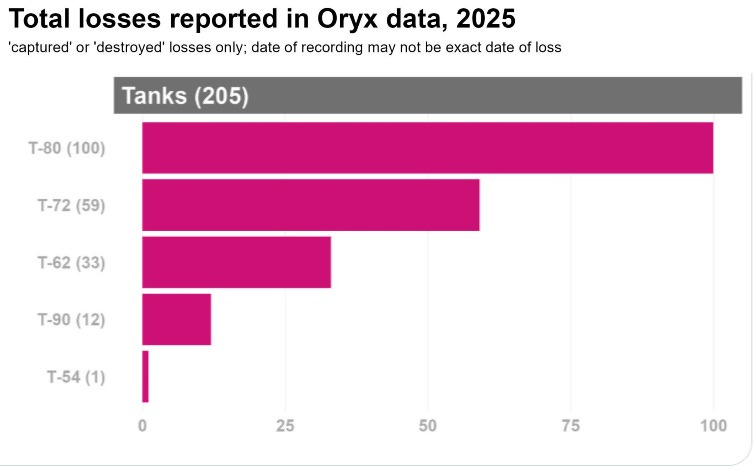
Put the two trends together and you get the following: Russian tank losses are trending down toward 400 a year and less, while Russian tank production of brand new, non-refurbed, tanks is already at 300+ according to the CIT report, and is trending positively upward with the acquisition of major new equipment lines as proven by procurement tenders analyzed by the team.
That means—if it hasn’t already done so—Russian tank losses and production will soon converge to be a total net zero, which would balance out the tank production as infinitely sustainable from that point forward.
The CIT report notes that these aren’t even the most optimistic—for Russia—possible outcomes, given that the Russian T-80 Omsktransmash line has been in talks to be restarted since 2023 or so. If the line comes online sometime in the future to produce completely new T-80s—rather than refurbs and upgrades as it does now—then Russia will be gaining a large net positive in new tanks over losses.
Recall that the net zero equilibrium that may have already been reached only pertains to brand new tanks, i.e. T-90Ms. But in terms of total tank production, which includes all the refurbished and upgraded T-72B3Ms, T-80BVMs, T-62Ms still being sent to the front, Russia has now vastly surpassed losses. The total tank production when you count these amounts to 1200-1500 per year, and we just learned that Russia’s tank losses are now trending toward ~400+ per year total. That means Russia has already completely staunched the bleeding of its heavy armor—it’s simply that the above mentioned refurb hulls will eventually run out, since there is only a finite number of them. This is why the T-90M equilibrium with losses is more important, as those can be produced indefinitely.
