

US Establishment Shell Shocked by Rapid and Paradoxical Advancement of Iran's "Lethality"

The US press commentariat continues to show great astoundment at Iran’s paradoxically growing capabilities:

Summary of the piece for those not wanting to read it in full:
Iranian missiles are becoming faster and more sophisticated, despite attacks by the US and Israel - The Wall Street Journal.
Despite airstrikes by the US and Israel targeting military infrastructure, storage facilities, and factories, Iran has retained a significant portion of its ballistic arsenal (estimated to be in the thousands of units) and the ability to continue developing and producing new weapons.
The publication emphasizes that over time, Iran has shifted its focus from slow-moving drones and outdated missiles to fast-acting, solid-fuel ballistic missiles with high accuracy. The new missile modifications are quicker to prepare for launch and have maneuverable warheads, which significantly complicates their interception.
For Israel and US forces, intercepting massive ballistic strikes requires the constant expenditure of expensive anti-missile systems (such as Arrow 3, THAAD, and Patriot), the stockpiles of which are limited. The WSJ notes that Iran has learned to exploit vulnerabilities in multi-layered missile defense systems by overwhelming them with dozens of fast-moving targets simultaneously.
It begins with the opener:
After nearly five months of war, Iran’s missile capabilities remain lethal. At least two U.S. servicemembers were killed in Jordan on Saturday following an Iranian attack of ballistic missiles and drones.
No one can quite seem to figure out how it’s possible that under such “unprecedented” US bombardment, said to be “degrading” Iran beyond recognition, the country can continue to increase the lethality of its strikes.
The article notes the US is even trying to identify “additional remains” at the same Jordan airbase where American servicemen were just killed, which means early rumors of even more casualties being buried under the rubble are likely true:
In addition, U.S. officials were working Sunday to try to identify additional human remains found at the site in Jordan as a third servicemember remained missing following the attack. And another U.S. servicemember was killed this weekend during the controlled detonation of a downed Iranian attack drone in Northern Iraq.
But getting back, WSJ’s chief question arises:

It goes on to highlight Trump’s claims from early June that Iran’s military had been “totally destroyed”, contrasting that with the paradoxical realization that Iran’s ballistic missiles are only getting “faster” and “more maneuverable”, which reflects a military that is “adapting, not necessarily crumbling.”
This has erupted into a cacophony of bewilderment in the MSM, which now wrestles with the question of where Iran is getting this wondrous “new technology”.
Trump, admitting that Iran “slipped something through” in Jordan, blames the Jordanian air defense operators, claiming that if other better operators had been there instead, the US would not have suffered the casualties that it did:
So, the US can’t afford its own operators to protect its own bases and troops? What gives?
This “newfound” Iranian capability was best evidenced by a series of leaked photos claimed to be from the site of the hit US base in Jordan—read the portion highlighted in red:
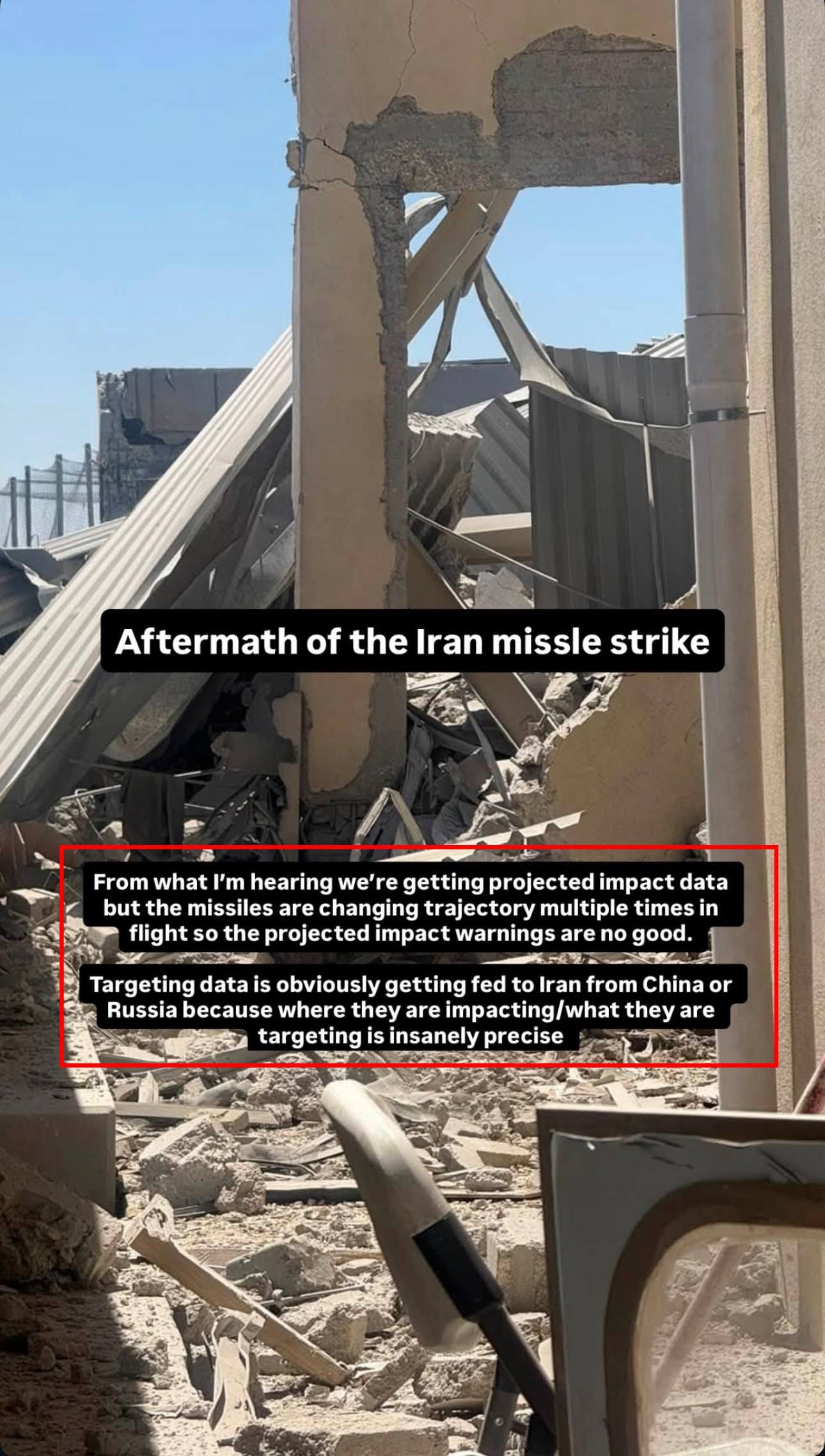
From what I’m hearing we’re getting projected impact data but the missiles are changing trajectory multiple times in flight so the projected impact warnings are no good.
Targeting data is obviously getting fed to Iran from China or Russia because where they are impacting/what they are targeting is insanely precise.
What’s the real secret to this newfound accuracy? Is it the Chinese/Russian targeting, or does it have more to do with Iran’s own increased missile capabilities?
The answer:
