


Yesterday for the first time in the war, Russia struck one of the major Dnieper river bridges with a ballistic missile. After weeks of seemingly experimental “probing” strikes with drones on both the Southern and Northern bridges in Kiev, Russia finally used what is claimed to be an Iskander to hit the Southern bridge.
Geolocation photos proving it to be the key Southern bridge:


A precision ballistic missile strike hit directly in front of the Southern Bridge’s metro tunnel portal, on the Vydubichi station side, on the right bank of the Dnieper.
It is difficult to say whether this was intentional or exceptionally lucky, but metro trains will not be crossing this bridge for quite some time.
To keep road traffic across the bridge suspended for an extended period, similar hits would also be needed on the road lanes.

There are a few important things to say about this strike.
Firstly, the accuracy was remarkable. The missile hit the exact dead center of the train line, rather than the two outside roadways. A close-up view to demonstrate roughly where it hit:
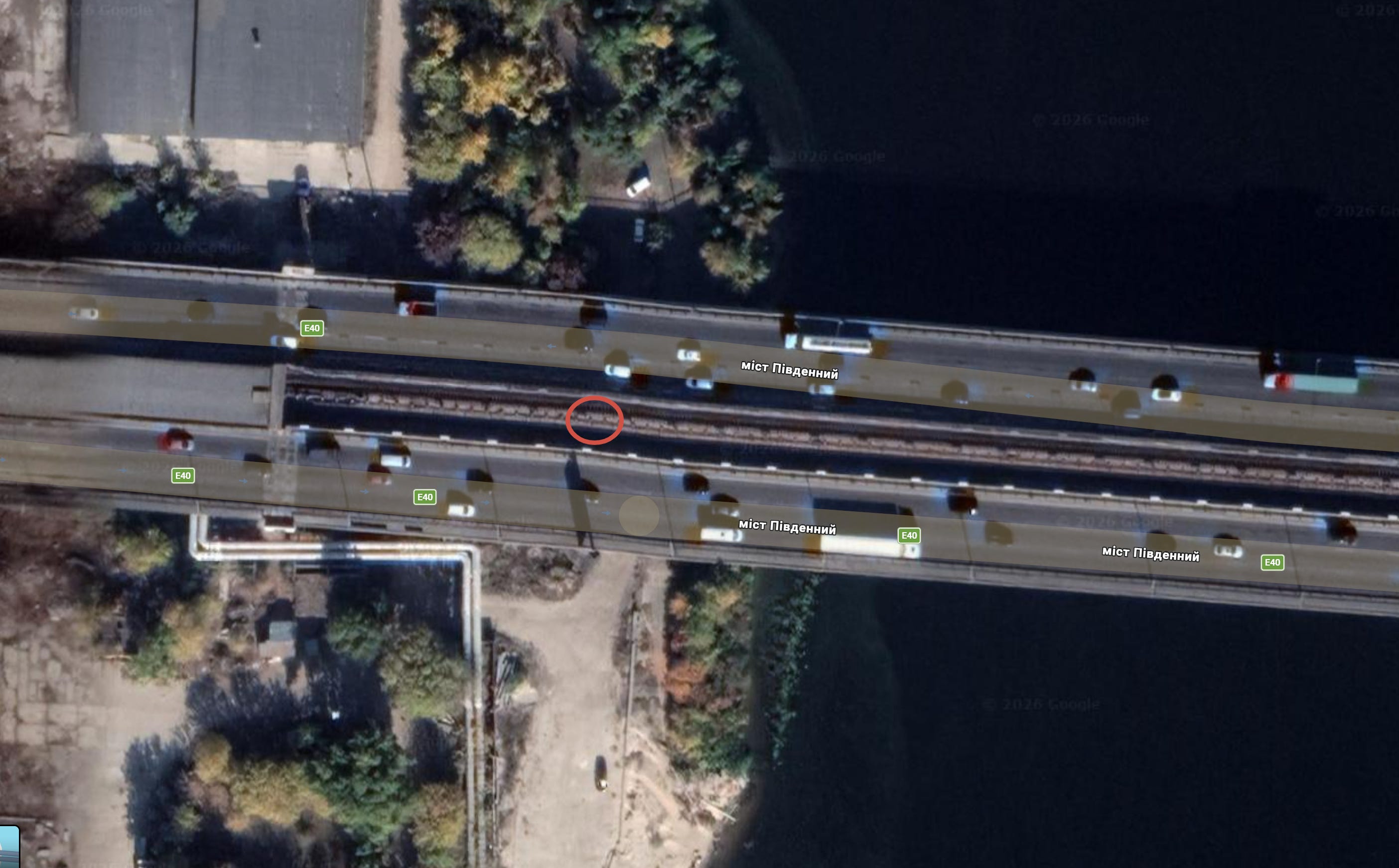
If we are to assume this was intentional—perhaps to avoid civilian traffic on the outside roadway, to hit the railway alone, or simply to aim for the center-most load-bearing portion of the structure—it would put the Iskander’s CEP accuracy into the narrowest possible ~5m range, rather than the 10-15m often assumed by Western sources.
Granted, there have been some occasional questions raised about the accuracy of Russian missiles, as there have been a few notable and inexplicable misses. This could have been due to EW or other malfunctions, but when the missile is functioning well it appears capable of extreme accuracy, particularly compared to that of Russian glide-bombs, which were recently seen missing the Zaporozhye bridge:

That said, it should be mentioned that in this past week, Russia also hit the Zaporozhye bridge with Geran drones, reportedly once more targeting the cable stays just as they did in Kiev earlier in the month (the second part of the footage reportedly shows glide-bomb attacks against the bridge):
But getting back to the Southern bridge in Kiev. There were some initial claims that four Iskanders actually hit the bridge, although we were shown damage only from a single one.
While accurate, the attack shows something we’ve been writing about here for years: that it would take dozens of missiles to irreparably ruin such a bridge. Back in early 2023, we wrote here that it could take Russia’s entire remaining cruise missile arsenal to try and take down every Dnieper bridge:

In hindsight, the “6 missiles per bridge” estimate is likely too low, and it would not be surprising if it took many more than that, particularly when you factor in potential misses and malfunctions.
We can see that a feared Iskander can only create a large pothole in the top-most layer of the Soviet-constructed bridge, with the interior structure receiving questionable damage. It is interesting, however, that a separate much-smaller hole was seen behind Klitschko on the roadway surface portion of the bridge, outside of the interior railway line:
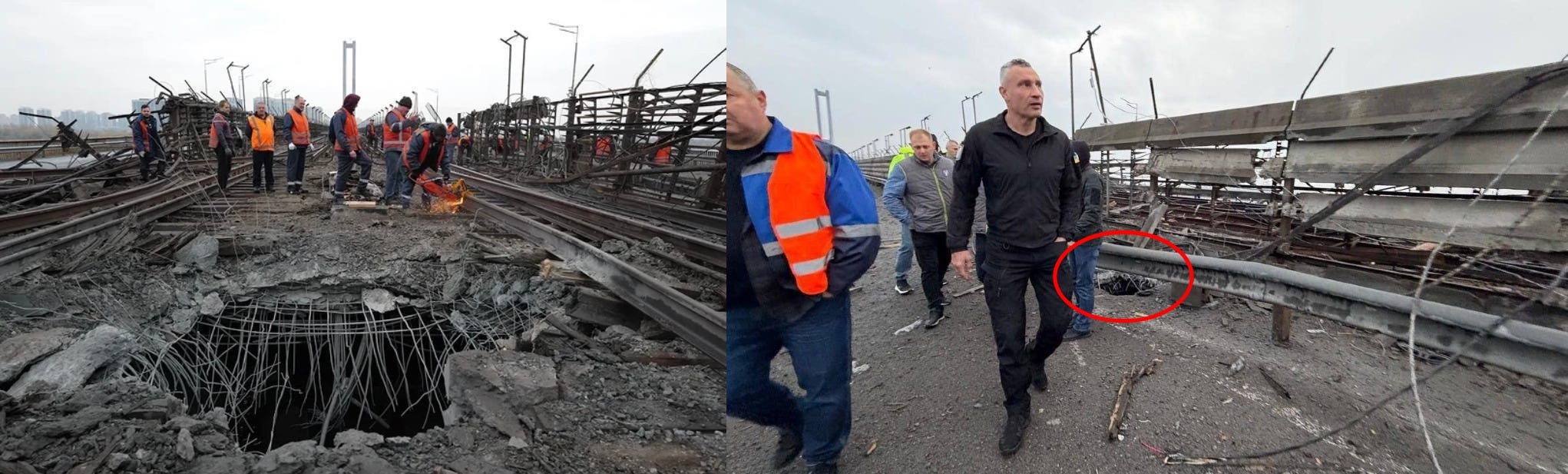
It’s impossible to tell what that hole was caused by, but certainly not an Iskander.
For reference, compare the size of the holes that HIMARS rockets left on the Antonovsky bridge in Kherson back in 2022:
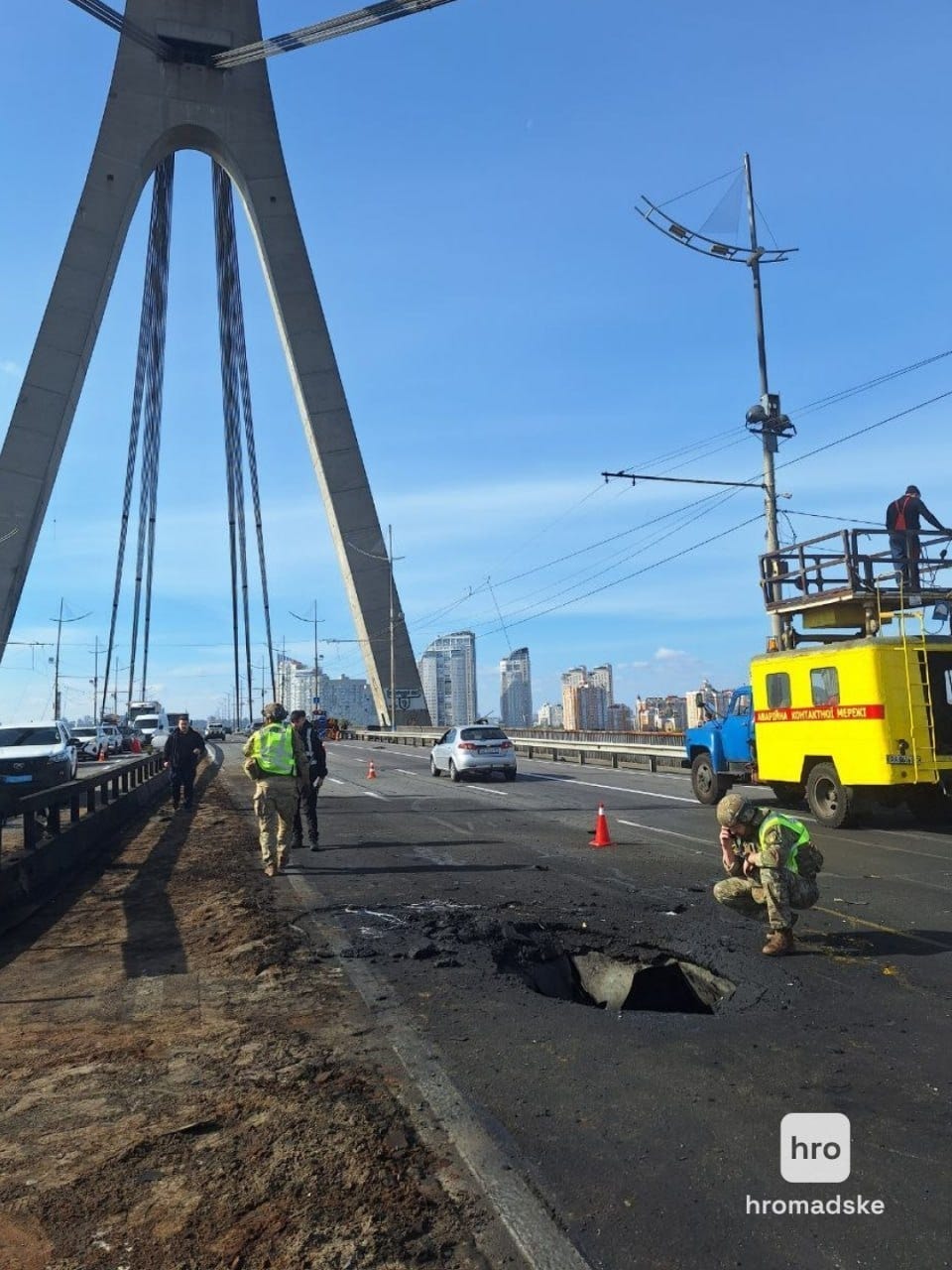
The HIMARS barely penetrated some of the rebar layering, creating holes roughly 1/5th or less the size of the Iskander damage. The same goes for the hole created by a Geran drone on the Kiev’s northern bridge earlier this month, which is similar in size to the HIMARS one:
Ukrainian authorities have announced plans to receive “mobile bridges”—presumably pontoons—from partners in the next few months:

After the attacks, Ukrainian bridges have begun being covered with various types of anti-drone netting, here seen on the Zaporozhye bridge which has been hit with a series of Geran drone strikes over the past month:
For now, we cannot conclude much other than the fact that Russia’s campaign against Ukraine’s bridges is at least proceeding in a semi-systematic fashion, although it still appears to be in a kind of “experimental” phase. There are many ways we can speculate on why this is: Russia could be testing different types of munitions against different sections of the bridge to gauge the effects; i.e. Gerans against cable stays, penetrative warheads against the roadways themselves, etc.
Also, Russia may not want to launch one single large-scale barrage with many munitions against a bridge because that would incur mass civilian casualties, given all the cars traversing the bridges at any given time. In conjunction with this, Russia could be attempting a deliberate “slow degradation” campaign in order to drain as much of Ukraine’s resources as possible; i.e. instead of mass-bombing the bridge to disable it all at once, you “peck away” at it piece by piece while allowing time in between for shut-downs, chaos, Ukrainian repair efforts, etc., which slowly drains the state. A chronically damaged bridge in a constant state of disrepair is in some ways worse than a totally disabled bridge; it’s why in past wars opposing troops were often purposely wounded with shrapnel rather than killed outright, in order to burden the enemy’s logistics with having to transport and deal with the injured.
While we’re on a technical topic, let us mention the interesting admission that Elon Musk just made yesterday regarding Starlink. It turns out the real reason Musk is terrified of allowing Starlink to be exploited as a military asset is because he fears Russia could Kesslerize earth’s orbit and destroy his entire space empire:
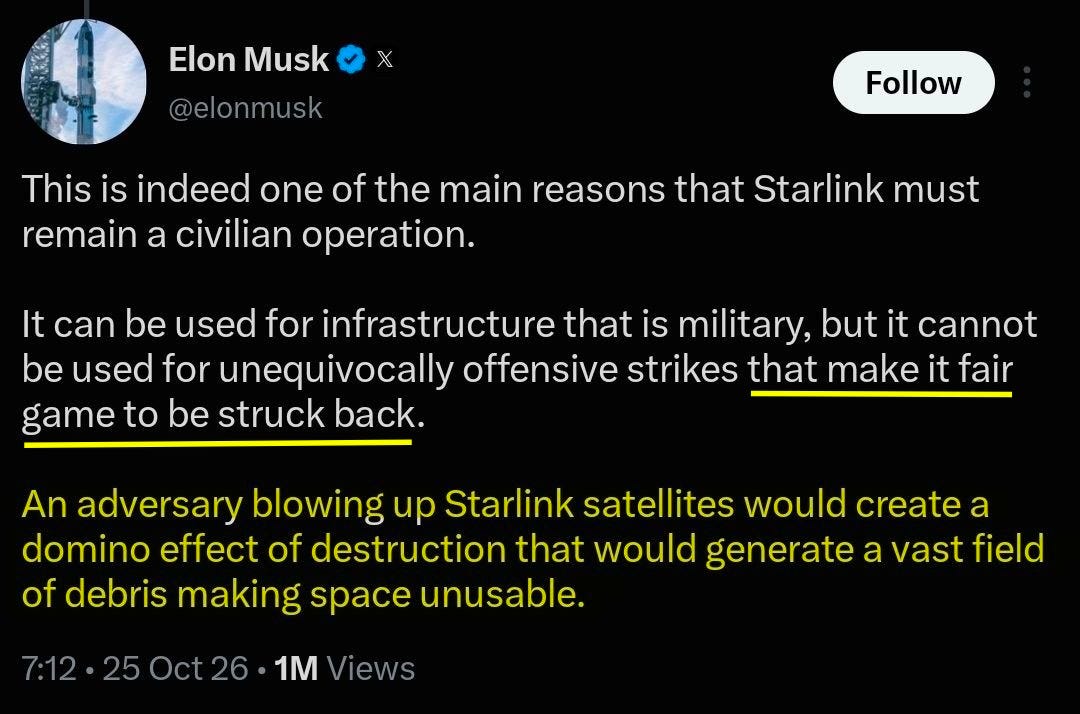
The reason this admission is startling is because it stands in stark contrast to Musk’s previous cocksure attitude on the issue, wherein he once bragged that Russia could never appreciably take out Starlink satellites because SpaceX could “launch them into space faster than Russia can take them out.”
Now suddenly he’s worried. Could this be the reason?


From the official Defense Intelligence Agency press release two days ago:

Which links to this newly released report: https://www.dia.mil/Portals/110/Images/News/Military_Powers_Publications/Challenges_Security_Space_2026.pdf
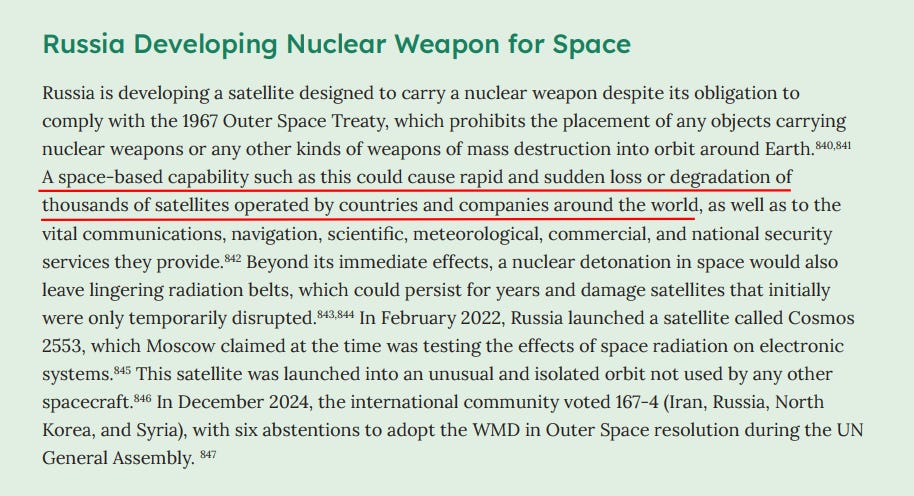
Musk could also be cunningly thinking ahead. Now that Russia’s own Starlink analogue will be rolling out in the coming years, he may fear the competition: Starlink could tarnish its reputation as a “neutral” civilian carrier by participating in offensive warfare. This would give Russia major future leverage in convincing Global South countries to use the more “friendly” and “neutral” Rassvet system over the Starlink, which could be turned militarily against them at any time. It’s akin to the previous jostling for market share between Glonass and GPS.
Continuing the technical line, another development this week was the announcement by Ukraine’s Fire Point that the infamous “Flamingo” cruise missile, which was meant to be the next wunderwaffen to bring Russia to its knees, has had its production entirely shut down and written off as a failure:

Fire Point’s CEO Irina Terekh confirmed the news, admitting that the project was just an “experiment” that was meant more for political effect than anything else:
In short: It was a PR vanity project, as we long suspected.
RWA has the most accurate likely explanation for the failure:

It is interesting given that Zelensky told Steven Bartlett in an interview just this past week that Ukraine was the “talent forge” of the USSR:
“They called Ukraine the Soviet Union’s forge of talent. There were so many scientists, engineers, universities, a huge intelligentsia. Many people who came from Ukraine went on to run various institutions and ministries in the Soviet Union. Ukraine was the intellectual part of the Soviet Union. Ukraine was always involved in rocket manufacturing. The biggest rocket manufacturing was here, nuclear weapons, which Ukraine handed over. A lot of things were made in Ukraine.”
Interesting that this forge of talent is now recycling the USSR’s leavings, all while ridiculing and disowning its Soviet heritage. We’ve spoken before about the latest Ukrainian ballistic missile being a copy of the USSR’s S-300, amongst many other such repurposed weapons. Why is it that the backwards, backwater “Russian” side of the USSR continued onward toward the superpower status it now globally represents, while the “unique” and “special” Ukrainian state turned into a depopulated, third world cesspit?
A telling snapshot of “talent forge” and “intellectual center” Ukraine’s post-Soviet development versus that of “Mordor”:

Maybe intellect is overrated?
Your support is invaluable. If you enjoyed the read, I would greatly appreciate if you subscribed to a monthly/yearly pledge to support my work, so that I may continue providing you with detailed, incisive reports like this one.
Alternatively, you can tip here: buymeacoffee.com/Simplicius
You know, Elon, if you don't want space to be Keslerized because countries start blowing your starlink up you should not have let it be weaponized. If you had said hell no to the Ukraine, Starlink is neutral and not up for military use it wouldn't be a target. You made it that way. Just like how the US made the dollar a target by weaponizing it and Europe made IBAN a target by weaponizing it. Moral of this story, if you have a unique world wide service and you want people to keep on using it and not develop a competitor, don't start using it as a weapon.
First! Thanks Simplicius!