

Trump Cancels Last Minute Attack Amidst Reports Iran Has Now Clocked US Tactics

In an intriguing development, Trump was set to go all-in on a new round of Iranian strikes, only to mysteriously pull back at the last moment. Trump himself cited the three most powerful Arab leaders in talking him down at the eleventh hour:
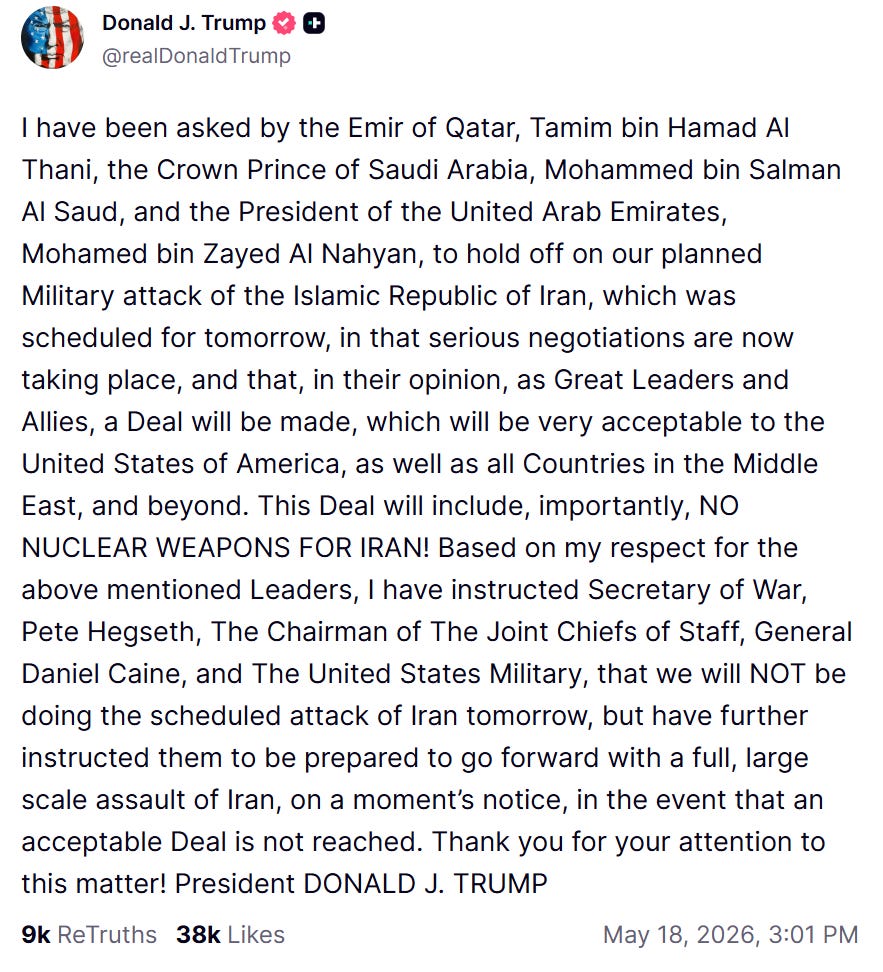
But reports immediately began pouring out that the reality was in stark contrast to Trump’s face-saving version above.
Many commentators cited the new NYT report as the real reason for the pull-back:
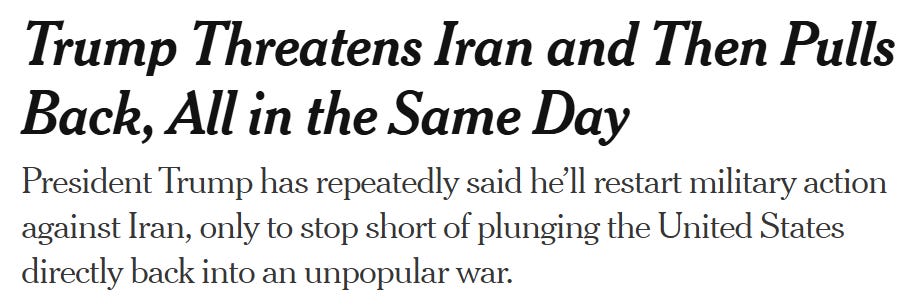
The report first corroborates much of what we’ve been discussing here for months now, about how the US is infact incapable of whack-a-moling the scattered Iranian ballistic sites:
Many of Iran’s ballistic missiles were deployed from deep underground caves and other facilities carved out of granite mountains that are difficult for American attack aircraft to destroy, the official said. As a result, the United States largely bombed the portals of the sites, collapsing and burying them — but not destroying them. Iran has now dug out a significant number of those sites.
But the key passage revealed that with Russia’s help, Iran simply became too effective at combating the US, causing the Americans to become too predictable to succeed in the given objectives:
Iranian commanders, possibly with Russian help, studied the flight patterns of American fighter jets and bombers, the U.S. military official said. The official warned that the downing of the F-15E jet last month and the groundfire that struck an F-35 revealed that American flight tactics had become too predictable in ways that allowed Iran to defend against them more capably.
Perhaps most important, the U.S. military official said that while five weeks of intensive bombing may have killed several Iranian leaders and commanders, the war has left a more hardened, resilient adversary. The official added that the Iranians had repositioned many of their remaining arms and instilled a belief that Iran can successfully resist the United States, whether by effectively blocking the Strait of Hormuz, attacking energy infrastructure in neighboring Gulf states or threatening American aircraft.

In a separate piece, CNN highlighted another fact readers will note we’ve long established here—that Iran has rebuilt whatever was destroyed by US’s ineffective strikes “far faster than expected”:
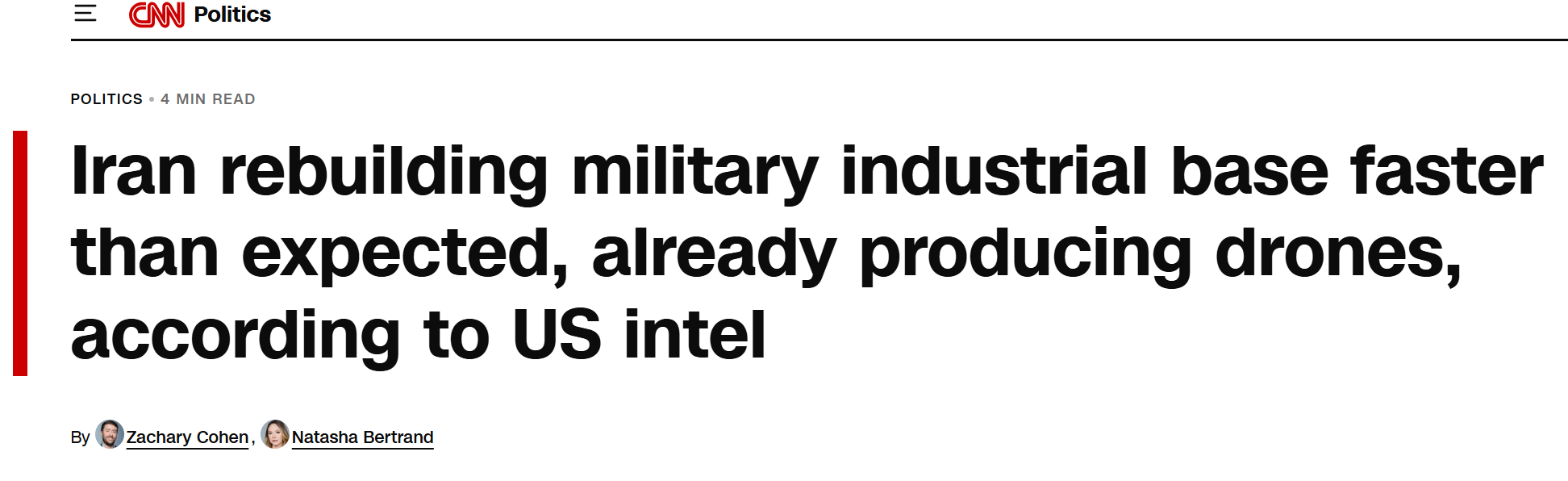
And the customary walk-back:
It also calls into question claims about the extent to which US-Israeli strikes have degraded Iran’s military in the long term.
Even CNN admits to the now-parodic ever-shrinking estimates of Iranian’s losses:
CNN reported in April that US intelligence assessed that roughly half of Iran’s missile launchers had survived US strikes. A recent report increased that figure to two thirds partially due to the ongoing ceasefire providing Iran with time to dig out launchers that might have been buried in previous strikes, according to sources familiar with the intelligence.
Apparently, Iran was only set back by “a few months”—but those few months have already passed during the ceasefire, which means Iran has already reconstituted, and Araghchi’s given figure of 120% was likely accurate all along:
One of the sources familiar with recent US intelligence assessments told CNN that the damage to Iran’s defense industrial base has likely set its ability to reconstitute back by a matter of months, not years. And some of Iran’s defense industrial base remains intact, which could further accelerate the timeline for reconstituting certain capabilities, the source noted.
Another humorous Congressional exchange:
Senator: Can you tell us how the US, with a $1 trillion dollar defense budget, has been held hostage by Iran in Hormuz?
General: Iran has a lot of small boats and other capabilities, they are holding the world economy hostage.
Senator: So, the US military can’t do anything about it…?
Crickets
Star Iranian FM Abbas Araghchi had an alternative view:
Translation: “Hormuz is open, so long as all vessels go through the Iranian checkpoint.”
Bloomberg now ups the estimate of the total US Reaper losses to $1B:

And WaPo adds on new loss figures for US’s most high-value air defense systems, highlighting how the US drained its most critical systems for the sake of Israel:
According to the Washington Post, citing a Department of War assessment they were given the details of, the U.S. used more high-end missile interceptors defending Israel than Israel used themselves. Per the report, citing U.S. officials speaking on the condition of anonymity, the U.S. used more than 200 Terminal High Altitude Area Defense (THAAD) interceptors and 100 SM-3 and SM-6 interceptors during operations to defend Israel.
In stark contrast to the U.S. expenditure of munitions, Israel fired 90 David’s Sling interceptors and under 100 Arrow interceptors in defense of its own territories. Per one U.S. official, “In total, the U.S. shot around 120 more interceptors and engaged twice as many Iranian missiles.”
However, the report does say, citing a U.S. official, that such a dynamic, where U.S. interceptors bear the brunt of incoming fires, was previously agreed upon when U.S. and Israeli military decision-makers were planning out how to employ an extensive joint anti-access area-denial (A2/AD) framework.
The noteworthy revelation about this is that it proves it was the US’s most advanced systems that were incapable of stopping Iranian attacks. At least if it was mostly Israel defending, the US could have an argument that THAAD and SM-6s could have cleared the skies of Iranian missiles, if they wanted to. But in reality, it was US’s most high-level systems that were playing the leaky sieve against Iranian strikes the whole time.
Another very instructive retroactive admission came from the Pentagon, which confirmed the earliest speculations about the tanker crash during the Iran war were in fact true:
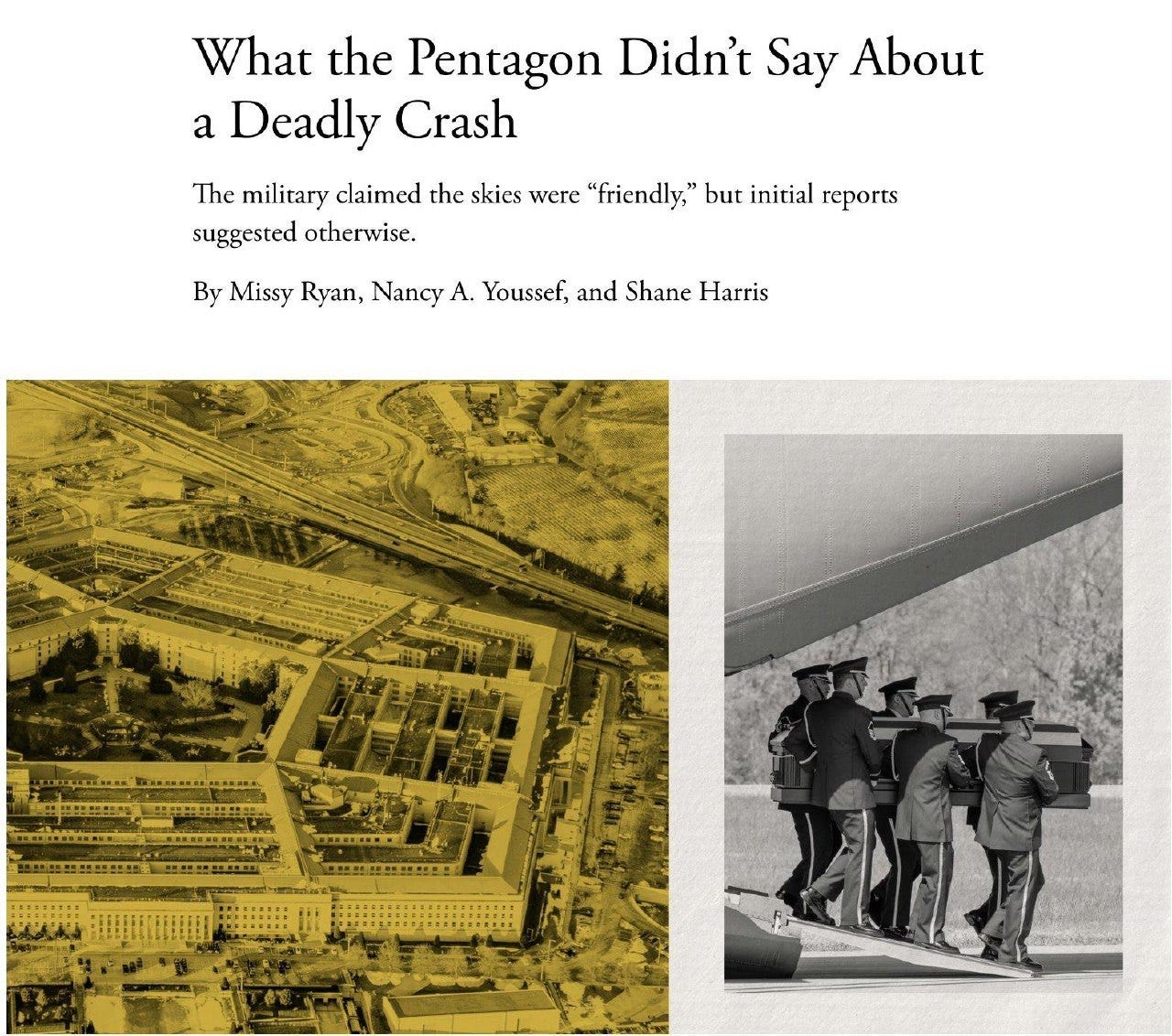
Remember when two US KC-135 tankers appeared to collide in the air, with one of them crashing and killing its entire crew of six US airmen: the US attempted to downplay it as some sort of freak accident, while we put the pieces together about how the craft likely veered into each other while dodging Iranian fire.
Now it’s been confirmed by insiders:
The same day, U.S. Central Command said that the crash over Iraq’s western Anbar province had occurred in “friendly airspace” and had not been caused by hostile fire.
Initial intelligence reports told a different story. They indicated that the U.S. government had detected anti-aircraft fire by Iran-backed militias in the area around the time of the collision and that the pilots may have been forced to take evasive actions.
This proves that virtually all the earliest assessments of the US military’s performance in Iran were correct and continue to be proven true retroactively: everything from the true extent of US losses, to that of Iranian losses, to even how the US losses came about. In each case, the US attempted to downplay incidents as mere mishap or friendly fire, as when the Kuwaiti F-18 shot down two US F-15s, but each time we came to learn that Iran had played a direct role in the losses.
If that all wasn’t enough, Robert Kagan has penned another urgent screed against Trump’s Iran war for the Atlantic:
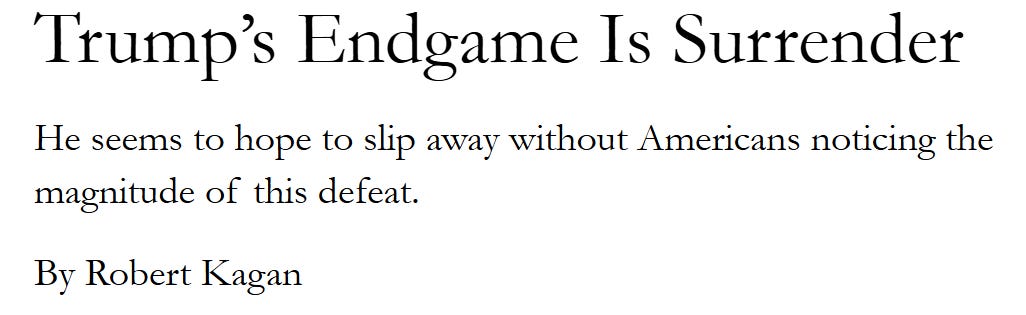
The fact that the occasional article-scribbler is now hyperventilating out piece after weekly piece betrays the urgency of the matter.
In the opener, Kagan believes that Trump’s new threats of additional strikes are nothing more than a bow-taking off-ramp to exit the war with an ostensible “win”:
The outlines of President Trump’s endgame in the Iran war are now emerging…Trump reportedly explained that the United States was negotiating a “letter of intent” with Iran that would “formally end the war and launch a 30-day period of negotiations” on Iran’s nuclear program and the reopening of the Strait of Hormuz.
The purpose and effect of such an agreement should be clear: The United States is walking away from the crisis. Trump may launch another limited strike to look tough and satisfy the demands of the war’s supporters, but it would be a performative gesture. Endgame in this case is a euphemism for “surrender.”
Kagan rightly notes that Iran’s terms of settlement are those of a victor—Iranian leaders know full well they have won, and they can easily see through Trump’s jaded hocus-pocus attempts to manipulate the post-war information field in the US’s favor.
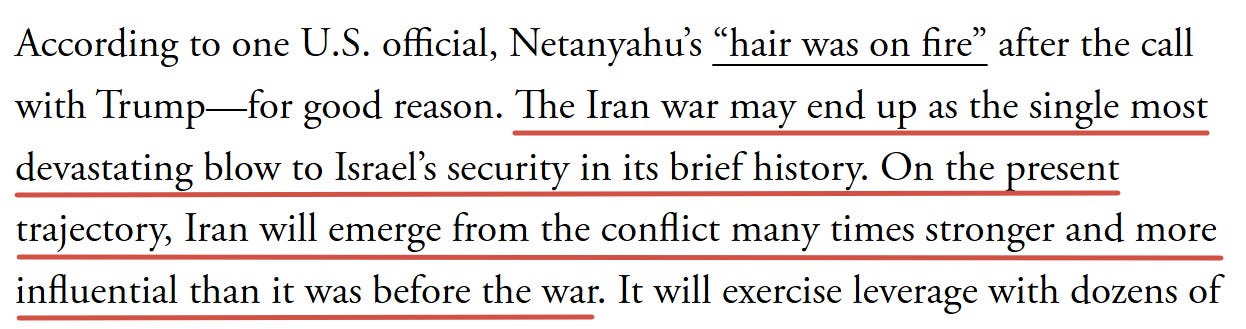
On the present trajectory, Iran will emerge from the conflict many times stronger and more influential than it was before the war.
Note the boldness in Kagan’s prediction: the typical journalistic hack would have used the softener “Iran may emerge…”—but Kagan knows the score.
Kagan again offers no solutions, but simply outlines the dismal reality: that Iran will soon be the natural great power of the region, and all will bow before its ascendant geopolitical influence. As the general told the senator in the earlier video, the US with its trillion dollar monopoly defense budget can do bupkus about it.
Now, amidst Trump’s latest threats to restart the conflict there are reports that Iran will not hold back:
BREAKING: Iran is preparing to continuously fire hundreds of missiles per day at Gulf energy infrastructure, refineries, ports, and water desalination plants as soon as the US resumes strikes, per NYT.
Iran’s IRGC says it will “return the Emirates to the era of riding camels” and “occupy Abu Dhabi” if necessary. The Houthis would also immediately shut down the Bab el-Mandeb Strait to open up a second maritime front against the US, with initial steps toward the blockade already taken.
Iran appears to even have given the treacherous Emiratis a little taste of things to come, should they dare tangle with the Persian lion once more:
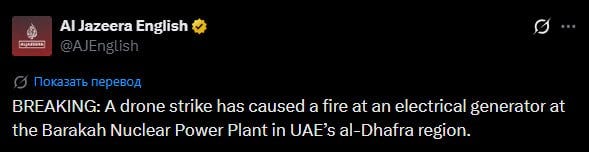
It seems the ball is once more in Donald’s court, as his options grow worse and worse by the day.
For now, Kagan’s predictions are already proving true: Iran has established the official Persian Gulf Authority with its own official X account which now dictates all terms in Hormuz, to Trump’s great chagrin:


NEW: Today, 30 ships that contacted the Persian Gulf Strait Authority (PGSA) were issued transit permits for the Strait of Hormuz, after paying the necessary tolls and signing the relevant documents
The ships will be safely guided through the Strait of Hormuz according to the guidelines and regulations of the Islamic Republic.
Transit will proceed in a phased manner and in accordance with Iran’s traffic separation scheme.
Trump naturally appears to be getting bored of things not going his way, and has already set his sights on Cuba once more.
Will he have better luck there?
Your support is invaluable. If you enjoyed the read, I would greatly appreciate if you subscribed to a monthly/yearly pledge to support my work, so that I may continue providing you with detailed, incisive reports like this one.
Alternatively, you can tip here: buymeacoffee.com/Simplicius
It wouldn't surprise me if the US backs away from Iran because it has nothing to gain and a lot to lose. The US economy can't afford the risk of a greater conflict with Iran. The cost-benefit doesn't fit. Trump has already practically destroyed himself in the midterms. He's on a tight leash politically. His allies in the Middle East are telling him to pull back at the risk of facing economic armageddon if the desalination plants and oil infrastructure are destroyed. Israel, on the other hand, wants to extend the war with Iran. I suspect Trump wants an exit plan despite the double-talk bravado he speaks.
There's too much at stake for the global economy to mess around with intensifying conflict in the Middle East. I think this conflict will de-escalate. If I'm wrong, well, here comes $200 or more per barrel of oil, the UAE uninhabitable, and shortages globally on a scale too deep to fathom.
Iran demonstrated that it doesn't need an atomic bomb to defend itself because it has enough missiles and drones to light up the entire Middle East. Either they all get along, or they all blow up together. A detente in the Middle East has been established.
I think Brian Berletic's argument makes more sense every day. "The US isn't trying to open the Strait of Hormuz - it is literally blockading it and perpetuating a war that ensures insecurity around it indefinitely. The US is engaged in a controlled demolition of Middle East energy exports and a large part of the global economy. It is playing games to manage prices and markets as it does so - NOT trying to find a way "out" of consequences everyone in Washington knew about before launching the most recent war of aggression."
Check out Mario Nawfal's interview with Chris Martenson at the 41:37 min mark it show's a video of Elon Musk (when he was running DOGE) about the "magic money computers" he found.