

Testy New Interview Reveals the Changing Colors of Robert Kagan

It is always interesting to read Robert Kagan’s words, because they represent a glimpse into the heart of the neocon ideological crucible and how it has evolved and pivoted in the years following the disastrous global refutation of PNAC’s core ideological thesis.
The piece begins precisely around the idea of the forced pivot, as the interviewer’s first question digs at whether Kagan has undergone a “conversion” from his previous hawkish neocon stripe.
In his answer, Kagan gives the first eye-opening revelation into the mental gymnastics the PNAC archons now regularly utilize to justify their failed world views. Hindsight being 20/20, he now says that blowback was always part of the arithmetic—a cheap cop-out meant to excuse their failed experiment as intentional as a kind of face-saving ploy:
Robert Kagan: I don’t think so, because I never denied that blowback was a reality. In fact, my writing shows that when the United States is out there acting in the world, Americans tend to not even be aware of the effect of American power on other nations. And so they’re constantly shocked whenever the use of American power leads to a response. The best example is Japan and Pearl Harbor. Many Americans acted like it was out of the blue when Japan attacked us when, in fact, the U.S. pursued policies that were likely to lead to a Japanese attack. The same was true of 9/11 in the sense that it was at least in part a response to the American presence in the Middle East.
The question is, do you act even though you know that there is going to be blowback because the stakes are worth it. So, I never doubted it and, as I say, recognizing the effect of American power on other nations is an important part of my history.
Kagan gets immediately defensive over the interviewer’s perfectly natural callout of his hyper-interventionist advocacy. It’s clear that right from the get go, Kagan is setting a defensive tone as a kind of apologia and historical revisionism of his now-defunct former ideology.
Di Caro: Yet for decades you have advocated for U.S. interventionism and, in the case of the Iraq invasion of 2003, a preemptive war…
Kagan: Wait a minute. Can we stop right there? When you say that I’ve advocated for intervention for decades, what in particular are you talking about? I certainly supported the interventions in Bosnia and Kosovo, but it’s not like I was just calling for intervention everywhere at all times. That’s a shorthand that you use, but it’s what people think, you know?
He goes on to even outright reject the label of “neocon”, and for a reason so ludicrous it must simply be seen to be believed:
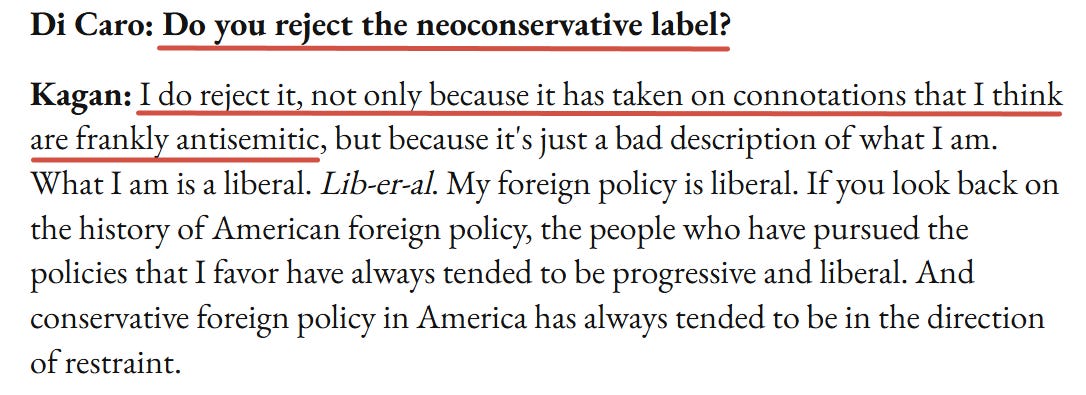
Oy vey!
Someone is extremely defensive over the repudiation of what is essentially his life’s work. This is nothing more than a desperate attempt to salvage credibility.
The keen interviewer pushes deeper, asking Kagan if he’s reconsidered his past support for US wars—most notably, Iraq—particularly in light of recent events and the disastrously unfolding Iran debacle. In accordance with the extremely tetchy tenor of his responses, Kagan again reverts to knee-jerk defensiveness:
Kagan: To answer your question, I haven't really fundamentally changed my mind. These are different circumstances. You'd have to assume that I had some kind of doctrine of always invading the Middle East whenever possible. But that has not been my doctrine.
It’s clear he realizes how bad he looks in hindsight and can’t help but adopt an almost whiny tone in attempting to rewrite his key role in America’s geopolitical depletion.
Most interestingly, he then springs into a rant about why the Iraq war was in fact justified because Iraq had done something even Iran would not dream of now doing: invaded multiple neighbors, including Iran itself, and fatefully, Kuwait. Iraq was therefore a threat in need of neutralization for this transgression.
But the irony is lost on Kagan: Iran may not have invaded anyone, but one Middle Eastern country certainly has been bombing and invading virtually every one of its neighbors. Israel has recently unjustifiably invaded both Syria and Lebanon, not to mention Gaza. Wouldn’t that—by the logic of his own justifications—mean Israel is itself in need of intervention?
The next exchange is pure gold as Kagan scurries from accountability for what the interviewer cites as a generational disaster that caused 180,000+ civilian deaths, chaos in the Middle East, millions of displaced people across the region, trillions of US dollars lost, et cetera.
Kagan first dismisses the numbers by explaining this all happened over the course of 10 years, as if a “gradual” genocide and ethnic cleansing is excusable compared to an instantaneous one. But when he’s pressed further, his shifty response is pure political pilpul:
